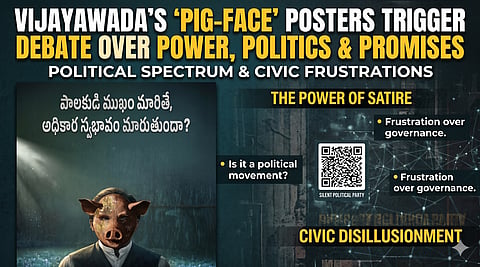

An unusual set of posters appearing at prominent junctions across Vijayawada has sparked a political debate, with an AI-generated image of a man in a formal business suit with a pig’s face catching public attention. Beside the image was a pointed question in Telugu: “Does the nature of power change when the face of the ruler changes?”
Pictures of the posters quickly spread across social media in Andhra Pradesh and Telangana, turning what appeared to be a late-night publicity campaign into a wider discussion about political accountability, public expectations and governance. Meanwhile, local police reportedly began examining CCTV footage to identify those behind the posters.
What Does the Pig-Face Image Signify?
Political satire is not new to Andhra Pradesh, but the choice of imagery has drawn particular attention. The combination of a well-dressed corporate figure and a pig’s face immediately reminds many of George Orwell’s famous novel Animal Farm, which explores how those who replace an existing regime can eventually become no different from their predecessors. The symbolism appears straightforward. The business suit represents the polished image of modern political leadership, complete with development promises, professional branding and carefully managed public relations. The pig’s face, meanwhile, suggests greed, self-interest and an unchanging appetite for power. Together with the question printed alongside it, the image appears to challenge the political establishment as a whole rather than target any particular party or leader.
Three Political Interpretations
The posters carry a QR code linking to an X account called ‘Silent Political Party’, which reportedly promotes the constitutional ideals of Liberty, Equality and Fraternity. This has added another layer of curiosity to the campaign.
Growing frustration with political promises
People in Andhra Pradesh and Telangana have witnessed several changes in political leadership over the years. However, many continue to face familiar problems, including traffic congestion, damaged roads, irregular water supply, poor drainage and civic administration issues. The poster's message seems to reflect a common public sentiment: governments may change, but why do everyday problems remain the same? It is this feeling of disappointment that gives the campaign its political edge.
Political satire or the launch of a new outfit?
Social media users are divided over the campaign's intentions. Some see it as an attempt to create a new space for political satire and public protest, recalling earlier online trends such as the 'Cockroach Party', which mocked political opportunism. Others suspect a carefully planned publicity exercise by a new political group or someone with political ambitions. The appearance of newspaper advertisements, coordinated social media activity and physical posters has fuelled speculation that the campaign could be testing public response ahead of upcoming local body elections. However, the identity of those behind it remains unclear.
A message with implications for local politics
The timing is also significant, with political activity around Vijayawada's municipal affairs drawing attention. Even without naming a party or leader, a campaign questioning the conduct of those in power can influence public perceptions of the ruling establishment. Such messaging can resonate particularly strongly when residents feel that civic issues are not receiving adequate attention.
Why Take the Message to the Streets?
At a time when political communication largely revolves around WhatsApp, Instagram, Facebook and X, the use of traditional wall posters has itself become a talking point. Online messages can easily disappear in the constant flow of social media content. Posters at busy junctions, however, attract attention from commuters and passers-by, encouraging conversations beyond digital platforms. The QR code adds a modern touch to this traditional publicity method, connecting people who notice the posters on the streets with the campaign's online presence.
The Question That Remains
For now, the police inquiry is focused on identifying those responsible for putting up the posters without permission. But the larger political question raised by the campaign is unlikely to disappear along with the posters. Ultimately, voters judge governments not just by their slogans, leadership changes or election promises, but by what they experience in their daily lives. Better roads, reliable drinking water, effective drainage and responsive public services are what matter most to ordinary citizens. Whether this campaign is a political experiment, a satirical protest or the beginning of a new political platform remains to be seen. But its central question has clearly struck a chord: When governments change, should the way power is exercised change too?