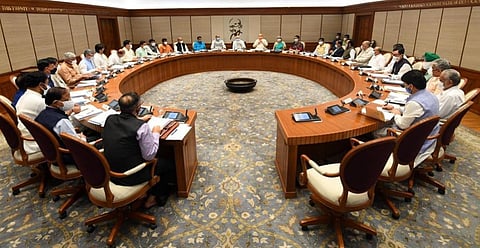

The Centre has taken another step towards implementing 'One nation, One Election.' The Union Cabinet on Thursday approved the One Nation, One Election' bill. According to sources, the Centre is likely to introduce a bill in this regard in the ongoing winter session of Parliament. Union Agriculture Minister Shivraj Singh Chouhan on Wednesday made a strong pitch for the implementation of 'One Nation, One Election.' He thinks that due to frequent elections, the development of the country is being hampered.
The BJP has long been keen on introducing the 'one nation, one election' system. This was also emphasised in the BJP's election manifesto before the Lok Sabha elections. If this rule is implemented, the National Election Commission will hold simultaneous Lok Sabha and Assembly elections across the country.
The central government argues that if this system is implemented, it will not only reduce the cost of elections but will also reduce the risk of repeated election restrictions and observance of the Model Code of Conduct. In that case, the government side also claims that more time will be available for development work.
For a long time, the Centre has been taking steps to implement One Nation, One Election.' A committee was formed to look into how realistic the 'one country, one election' system would be if it was introduced in this country. The committee was headed by former President Ram Nath Kovind. In March, the Kovind-led committee had visited Rashtrapati Bhavan and submitted a report to Droupadi Murmu. According to sources, the report proposes simultaneous elections to the Lok Sabha and Assembly in multiple phases. Regional elections like panchayat and municipal polls will also be held at the same time. The central government is likely to introduce the bill in the winter session.
However, the constitution should be amended to implement the 'one country, one election' plan. The government needs a two-thirds majority. The BJP had an absolute majority in the last Lok Sabha elections, but it may be difficult to get a two-thirds majority. As things stand, the NDA has 112 of the 245 Rajya Sabha seats. The opposition has 85. The government needs 164 votes to get a two-thirds majority. The NDA has 292 seats in the Lok Sabha out of the total 545 seats. To be two-thirds, 364 votes are needed.
