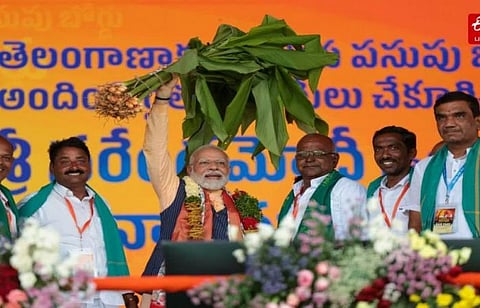

PM Narendra Modi has announced that the Centre has decided to constitute the National Turmeric Board taking into account the long-pending demand of the sector’s stakeholders. The board will come as a shot in the arm for turmeric growers as it helps in the promotion, processing, marketing and export of turmeric.
How Turmeric Board Becomes a Political Issue?:
Turmeric Board is the main political issue in Nizamabad Parliament constituency during 2019 Lok Sabha elections. BJP Present MP Dharmapuri Arvind, as a BJP candidate gave a written assurance on a bond paper of Rs 100 that Centre will set up a board in the Armoor area where Turmeric grown if he is elected as MP. He won the elections and Chief Minister K. Chandrashekhar Rao's daughter and then sitting MP Kavitha was defeated. After that she was elected as MLC.
Instead of Turmeric Board the Central Government has established the Spices Board extension counter in the Nizamabad district. But the farmers of that area did not back down from their demand to get Turmeric Boards. This became the main issue in the 2023 assembly elections. At this moment, before the elections, Prime Minister Narendra Modi cleared the line for setting up the National Turmeric Board. As announced in the public meeting in Nizamabad, the Union Cabinet met on the next day and gave clearance to the official proposals related to the board.
Nizamabad is one of the largest turmeric-producing districts in Telangana, and local Market Yard is one of the major turmeric markets in the State. Turmeric is grown on more than 75000 acres in the erstwhile Nizamabad district, farmers spends more than Rs 1.25 lakh per acre for the cultivation and on average gets yield of 20 to 25 quintals of turmeric. Farmers launched a movement demanding the establishment of NTB before 2006 and Swadeshi Jagran Manch also gave its support to their demand. In the later years, main political parties and people’s organisations joined the bandwagon.
What National Turmeric Board Do:
National Turmeric Board which would focus on growth of production and exports of the herb widely known for its medicinal properties. The union government has chalked out a plan to increase turmeric exports to Rs 8,400 crore, or USD 1 billion, per annum (by 2030) from the existing Rs 1,600 crore, said Union Minister Anurag Thakur, while briefing the media about the Union Cabinet decision in its meeting. Union Minister G Kishan Reddy said the decision to set up a board for turmeric fulfills a long-pending demand of farmers of Telangana, Maharashtra, Madhya Pradesh, and Karnataka.
Board will mainly concentrate on increasing marketing facilities at the global level.
Board is expected to give turmeric production and export professional attention.
Board will help promote research and development, focus on capacity building and skill development of Turmeric growers.
Board will promote the quality and food safety standards and adherence to such standards of the herb.
Board can be expected to implement a market intervention scheme with the help of Central and State governments to provide profitable prices for the farmers’ produce.
Farmers will get assistance from experts for improving the turmeric yield.
Farmers will get help in different areas ranging from value-addition in the supply chain to infrastructure-related works.
Centre to Constitute a Governing Body:
National Turmeric Board shall have a chairperson to be appointed by the Centre, members from the Ministry of AYUSH, Departments of Pharmaceuticals, Agriculture & Farmers Welfare, Commerce & Industry of the central government, senior state government representatives from three states (on rotation basis). Select national/state institutions involved in research, representatives of turmeric farmers and exporters, and a secretary to be appointed by the Department of Commerce will also be part of the board.
Telangana is the Top Producer:
India is a major producer, consumer and exporter of turmeric. After the pandemic, the health benefits of turmeric have received worldwide attention. Country produces nearly 1.1 million tonnes of turmeric, making up 80 per cent of the global output. India is a leading producer and exporter of turmeric in the world. Including Telangana states like Andhra Pradesh, Tamil Nadu, Orissa, Karnataka, West Bengal, Gujarat, Meghalaya, Maharashtra, Assam are some of the important states cultivates.
Turmeric can be grown in diverse tropical conditions from sea level to 1500 meters above sea level, at a temperature range of 20-35 degrees Celsius with an annual rainfall of 1500 mille meters or more, under rain-fed or irrigated conditions. Though it can be grown on different types of soils, it thrives best in well-drained sandy or clay loam soils with a pH range of 4.5-7.5 with good organic status. A number of cultivars are available in the country and are known mostly by the name of locality where they are cultivated. Some of the popular cultivars are Duggirala, Tekurpeta, Sugandham, Amalapuram, Erode local, Alleppey, Moovattupuzha, and Lakadong.
Uses of Turmeric in Traditional Medicine:
Turmeric (Curcuma Longa) has been used in Asia region for centuries and is a major part of Ayurveda, Siddha, Unani and Chinese traditional medicine.
Increasing demand for natural products as food additives makes turmeric an ideal herb as a food colorant.
Various medical researchers have demonstrated the anti-cancer and anti-viral activities of turmeric, leading to an increase in demand for turmeric in USA, Iran and Morocco.
Herb is used as condiment, dye, drug and cosmetic.
Powder use in religious ceremonies, added to foodstuffs for flavour and to colour. It is a principal ingredient in curry or masala powders.
Used as a dye in textile industry.
Used in the preparation of medicinal oils, ointments and poultice.
It is stomachic, carminative, tonic, blood purifier and an antiseptic.
Spices Board extension counter is already functioning in Nizamabad. In the past, the central government had given clarity that the Spices Board would do all the work done by the Turmeric Board. But the farmers felt that the extension counter would not be as profitable as the yellow board. That is why the demand for Turmeric Board has been continued. In country, Spices Board was constituted on 26th February 1987 under the Spices Board Act 1986 with the merger of the erstwhile Cardamom Board (1968) and Spices Export Promotion Council (1960). Spices Board is one of the five Commodity Boards functioning under the Ministry of Commerce & Industry. It is an autonomous body responsible for the export promotion of the 52 scheduled spices and development of Cardamom (Small & Large).
Farmer End “Bear-Foot” Protest:
Before concluding this story, let's know about the struggle of a turmeric farmer of Telangana. 71-year-old Mutyala Manohar Reddy of Palem village has been walking barefoot for 12 years. Do you know why?! This turmeric farmer has vowed to not wear any footwear until the board was established. On November 4, 2011, he embarked on a 63-day padayatra from Ichoda in Adilabad district, culminating at the feet of Lord Venkateshwara in Tirupati.
After more than a decade of agitations, Narendra Modi government is setting up a National Turmeric Board. Now, Manohar Reddy wore a new pair of slippers after PM Modi’s announcement. Manohar Reddy's journey may appear unconventional, but it stemmed from a deep-rooted commitment to the cause of turmeric farmers. His fervent wish was the establishment of the Turmeric Board, aimed at benefiting turmeric farmers like him.
There is no other living example to show the fighting spirit of Telangana farmers...!
