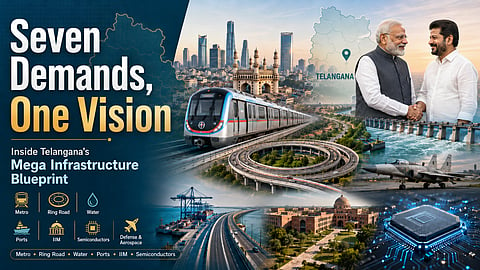

It is being called the "seven varas" (boons)—a multi-billion-dollar infrastructure wishlist handed directly from Telangana to New Delhi. But behind the ambitious headlines lies a highly calculated roadmap designed to solve real, everyday bottlenecks. From doubling the metro grid to unlocking water-sharing deals and carving out a direct gateway to the sea, here is a factual look at Telangana's boldest economic blueprint yet, and exactly what it takes to turn these paper plans into reality.
Telangana Chief Minister A. Revanth Reddy recently met Prime Minister Narendra Modi in New Delhi to lay out the state’s economic plans. He brought a solid roadmap with seven key demands—people in Telangana call these the “seven varas,” or seven boons. But these aren't lofty slogans. They're focused, detailed proposals meant to solve problems people deal with every day.
Hyd Metro Phase-II: The Lifeline Extension
The state wants to add 122.9 kilometers to the metro, building seven new corridors—a ₹38,595 crore project. Telangana is asking the central government to join hands in a full-blown Joint Venture to share the bill. Right now, anyone who relies on the city’s roads knows how bad traffic’s become. The current metro is packed, but it doesn’t cover the city’s fast-growing tech corridors and new neighborhoods. With central support, the expansion could finally match Hyderabad’s rapid growth, making commutes smoother across the city.
Regional Ring Road (RRR)
Telangana is pushing for cabinet and financial approval for both the northern and southern stretches of this key highway circling Hyderabad. It’s not just about securing funds—the state has already provided ₹626 crore to the NHAI and finished 90% of land acquisition for the northern half. Approving both sections together makes sense. It avoids endless delays and rising costs down the line.
An IIM for Hyderabad
The plan is straightforward: establish an Indian Institute of Management in Telangana. Hyderabad is already a heavyweight in education and technology, home to IIT, IIIT, and NALSAR. Yet, it stands out as one of the few major states without an IIM. The government’s even set aside 200 acres of clear, unencumbered land, ready for construction as soon as the go-ahead comes.
Maha Tanks on Tummidihatti Barrage
Revanth Reddy pressed the Prime Minister to resolve the years-old water-sharing standoff with Maharashtra. Telangana needs about 2,000 acres in Maharashtra to build the Tummidihatti barrage. If it’s built, the project will channel Godavari river water by gravity, bringing irrigation to 2.5 lakh acres in dry districts like Adilabad. This change can give thousands of farmers the water security they've been waiting for.
Expressways to the Sea
This demand is about opening up routes for Telangana’s goods. The proposal includes a 12-lane expressway from Hyderabad straight to Bandar Port in Andhra Pradesh, plus a 4-lane elevated corridor through the tiger reserve at Mannanur-Srisailam. The state is also asking for high-speed rail links to Chennai, Bengaluru, and Pune. With Telangana being landlocked, seamless routes to ports mean pharma and food processing industries get faster, cheaper access to international markets.
The "M-6" Mega City Fund
Here’s the pitch: create a special M-6 Task Force under the Prime Minister’s Office to direct ₹6 lakh crore toward India’s six biggest urban engines—Delhi, Mumbai, Kolkata, Chennai, Hyderabad, and Bengaluru. That’s ₹1 lakh crore for each city. These cities account for nearly a quarter of India's GDP. Investing in infrastructure now isn’t optional. It’s the only way to keep up with booming populations and bring Indian cities up to global standards.
Semiconductors and Defence Projects
Telangana wants major support under the India Semiconductor Mission 2.0, along with funds for an Electronics Manufacturing Cluster (EMC 2.0) at its upcoming “Future City.” The global race for microchips and tech dominance is on. Telangana is also pushing for quick approvals on a formal Hyderabad-Bangalore Defence Corridor, cementing its lead as an aerospace and high-tech manufacturing hub.
These aren’t vague ideas—they’re a hands-on, realistic plan for Telangana’s development. From Adilabad’s farmers waiting for reliable irrigation to IT workers caught in gridlock, these projects aim to fix problems you can see and feel. Now, it’s about the center and state joining forces to turn those plans on paper into reality.
