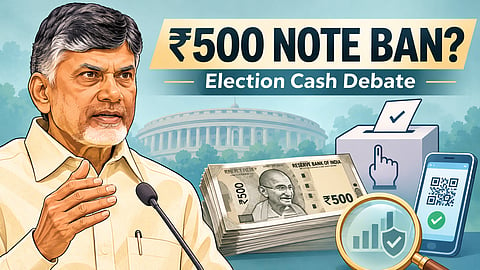

A decade after demonetisation, Chandrababu Naidu's call to withdraw Rs 500 currency notes has reopened an uncomfortable question: Can changing the currency curb electoral corruption, or will political money simply find another route? Ten years after India's 2016 demonetisation experiment, Chandrababu has brought the debate over high-value currency back into the political spotlight. Speaking in Amaravati around the tenth anniversary of the note ban, Naidu called for the withdrawal of Rs 500 notes, following the earlier discontinuation of Rs 2,000 notes. He advocated retaining only Rs 100 and Rs 200 denominations and accelerating the transition towards a predominantly digital economy.
Chandrababu's argument is rooted in a familiar concern: the enormous role of unaccounted money in elections, political financing and public life. His contention is that restricting high-value currency would make it more difficult to accumulate, transport and distribute large sums of cash for electoral purposes. But the proposal raises questions that extend well beyond currency management. Can another round of demonetisation achieve what the 2016 exercise failed to accomplish? Would smaller denominations genuinely disrupt illegal election spending? And, given Andhra Pradesh's intensely competitive political environment, does Naidu's intervention also carry a message for his principal political rival, Y.S. Jagan Mohan Reddy?
Political Calculus Behind Naidu's Currency Pitch
In Andhra Pradesh, the debate over black money inevitably intersects with the bitter political rivalry between the TDP-led NDA government and the YSR Congress Party. Since returning to power in 2024, the Naidu government and TDP leaders have repeatedly levelled allegations of financial irregularities against the previous YSRCP administration, particularly in liquor transactions, sand mining and land-related dealings. These remain politically contested allegations, with their individual merits requiring examination through the relevant investigations and legal processes.
Against this backdrop, Naidu's proposal to eliminate Rs 500 notes can also be viewed as a political statement. By projecting high-denomination currency as an instrument of corruption and electoral manipulation, he is seeking to position his government on the side of financial transparency while putting the previous regime under renewed political scrutiny. There is, however, a question of consistency. The use of money to influence voters has never been confined to one political party in Andhra Pradesh. The 2024 elections witnessed widespread allegations of cash distribution and inducements involving candidates and political formations across the spectrum.
Consequently, the opposition can reasonably question whether a campaign against high-value currency represents a genuine commitment to electoral reform or an attempt to gain political advantage through an issue that affects all parties. If the objective is to clean up elections, the proposed restrictions must apply equally to political funding and campaign practices across the board.
Would Abolishing Rs 500 Notes Really Stop Electoral Corruption?
Chandrababu's proposal has a straightforward logistical argument. If large-denomination notes disappear, moving substantial amounts of cash would require more physical space, manpower and transportation. A given amount of money would occupy considerably more volume in Rs 100 and Rs 200 notes than in Rs 500 notes. That could make certain forms of cash movement more cumbersome. But inconvenience should not be confused with prevention.
The Indian economy continues to depend heavily on physical currency, particularly in agriculture, rural markets, informal businesses and daily-wage transactions. According to the currency figures cited in the debate, Rs 500 notes account for approximately 85.5% of the total value of currency in circulation, amounting to more than Rs 35.27 lakh crore, and around 41.2% of the total number of notes.
If these figures are accurate, withdrawing Rs 500 notes would represent a major disruption to everyday economic activity. Small traders, farmers, transport operators and wage earners would face the immediate burden of exchanging and managing currency. Digital payments have expanded rapidly, but access, connectivity and digital literacy remain uneven. The larger question is whether the inconvenience imposed on ordinary citizens would produce a corresponding reduction in illegal political expenditure.
The Lessons of Demonetisation
The 2016 demonetisation exercise was presented as a major intervention against black money, counterfeit currency and corruption. It also generated considerable expectations of greater transparency in political financing. Yet, the problem of election-related inducements persisted through subsequent electoral cycles. Election Commission seizure figures, including the reported Rs 3,475 crore seized during the 2019 Lok Sabha elections and more than Rs 4,650 crore during the 2024 general elections, illustrate the continuing scale of the challenge. Seizures do not represent the total amount spent illegally, nor do they establish the precise extent of vote-buying. Nevertheless, they demonstrate that changing currency arrangements alone cannot eliminate the financial networks supporting electoral malpractice. Political financiers and intermediaries can adapt quickly. When one channel becomes difficult, alternative methods emerge.
Electoral Money Is No Longer Just About Cash
The mechanics of voter inducement have evolved. Physical currency remains important, but it is no longer the only means of influencing voters. Investigating agencies and election authorities have increasingly had to contend with a wider range of inducements, including transfers through intermediaries and mule accounts, digital wallets, prepaid vouchers, gold, liquor and payments towards household expenses or outstanding loans. Such practices, where intended to influence voting decisions, are difficult to tackle through currency restrictions alone.
The problem, therefore, is not simply the denomination of the banknote. It is the network of political funding, intermediaries, undisclosed expenditure and weak enforcement that sustains the system.
Why South States Remain Under the EC's Scanner
Election-related seizures in southern India have repeatedly attracted national attention. Andhra Pradesh, Telangana, Tamil Nadu and Karnataka have witnessed substantial recoveries of cash, liquor, precious metals and other inducements during major electoral exercises. The 2024 general election figures cited in the debate — including seizures exceeding Rs 1,300 crore in Tamil Nadu, Rs 202 crore in Telangana and Rs 176 crore in Andhra Pradesh — underline the scale of enforcement activity in these states.
Several factors help explain the intensity of election expenditure.
Fierce Constituency-Level Competition
Andhra Pradesh and Telangana have highly competitive political environments. In closely contested constituencies, relatively small shifts in voter preferences can determine electoral outcomes. This creates incentives for candidates to spend heavily on campaign mobilisation and, in some cases, resort to illegal inducements.
Strong Local Financial Networks
Real estate interests, contractors, business establishments and other influential local networks can contribute to the enormous financial requirements of constituency-level campaigns. The availability of such resources, combined with intense political competition, can push election expenditure beyond officially declared limits.
Politics of Competitive Welfare
Welfare promises have become central to electoral competition across southern states. While legitimate government benefits delivered through transparent Direct Benefit Transfer systems must be distinguished from illegal voter inducements, the growing expectation of tangible benefits has created a political environment in which parties compete aggressively over financial assistance and household-level support.
Weak Enforcement and Limited Deterrence
Large-scale seizures alone cannot establish electoral accountability. The effectiveness of enforcement ultimately depends on investigations, prosecution, convictions and timely action against those found guilty. Where the legal consequences are uncertain or delayed, the deterrent effect of election surveillance remains limited.
Real Reform Must Begin With Political Financing
Chandrababu's proposal brings attention to a serious weakness in India's electoral system: the influence of money over democratic choices. His emphasis on digital payments and financial transparency has merit as a long-term policy objective. However, withdrawing a widely used currency denomination is a blunt instrument for addressing a complex institutional problem. A meaningful electoral reform agenda must go much further.
Political party accounts need greater transparency and independent scrutiny. Campaign expenditure must be monitored more effectively, including spending routed through third parties and informal networks. Digital transactions and non-cash inducements require stronger surveillance, while election-related offences must attract credible and timely legal consequences. The debate must also address the opaque sources of political funding and the growing cost of contesting elections. Without tackling these structural weaknesses, restrictions on cash will merely encourage those involved in illegal transactions to explore different methods.
Reform or another Currency Experiment?
Chandrababu Naidu has raised an issue that deserves serious national attention. Money power continues to undermine the fairness of elections, distort political competition and weaken public confidence in democratic institutions. However, the success of an anti-corruption policy should be measured by the problems it actually solves, not by the toughness of its announcement. Abolishing Rs 500 notes may make cash handling more inconvenient, but it will not automatically dismantle the political and financial networks behind electoral malpractice. Nor should the economic burden of another currency transition be overlooked. India does not merely need smaller currency denominations; it needs cleaner political funding, accountable candidates and credible electoral enforcement. Until those reforms become central to the system, the fight against vote-buying risks becoming another battle over the banknote rather than a battle against the money power behind it.