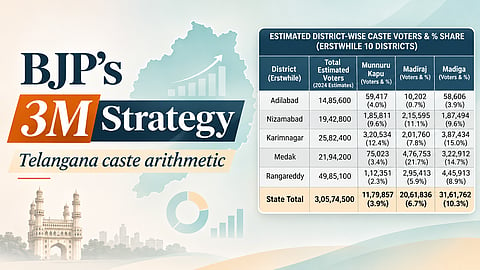

With a series of visits to Telangana by top national leaders, including Prime Minister Narendra Modi, Union Home Minister Amit Shah, BJP National President Nitin Nabin and Union Minister J.P. Nadda, the BJP appears to be stepping up its efforts to build a serious challenge to the ruling Congress in the state. Beyond its aggressive campaign on the Special Intensive Revision (SIR) of electoral rolls, the party is also working on a long-term social engineering strategy to expand its support base. At the centre of this exercise is what party strategists describe as the ‘3M’ formula — Madiga, Mudiraj and Munnuru Kapu. Amit Shah and national general secretary Sunil Bansal are understood to be among the key figures driving this strategy.
The idea behind the 3M formula is straightforward: bring three influential communities under one political umbrella and turn their combined numerical strength into an electoral advantage. According to Telangana’s Socio-Economic, Educational, Employment, Political and Caste (SEEEPC) survey, these three communities together account for around 76.71 lakh people, or approximately 21.58 per cent of the state's enumerated population of 3.55 crore. In a state where Congress, BRS and BJP are competing for political space, even a substantial shift in the voting preferences of these communities could influence results in several Assembly and Lok Sabha constituencies.
Number Game of “M3 Formula”
Each of the three communities brings a different kind of political strength to the proposed coalition. The Madigas form the largest component of the 3M strategy. With an estimated population of 36.58 lakh, accounting for 10.3 per cent of Telangana's population, they constitute nearly 59 per cent of the state's Scheduled Caste population. Their presence across almost every district makes them an important electoral constituency for any political party. Their longstanding demand for SC sub-categorisation has also given the community a distinct political identity. Prime Minister Narendra Modi's public support for the demand has provided the BJP with an opportunity to strengthen its relationship with Madiga voters. Their larger concentrations are found in Greater Hyderabad (3.07 lakh), Rangareddy (2.20 lakh), Nalgonda (2.13 lakh), Khammam (2.03 lakh) and Sangareddy (1.65 lakh).
The Mudiraj community is the second major pillar of this strategy. Including Mutrasi and Tenugollu, its estimated population stands at 26.39 lakh, or around 7.4 per cent of the state's population. It is considered the largest non-Muslim BC community in Telangana. Its influence is particularly visible across the erstwhile Medak, Mahabubnagar and Rangareddy regions. Medak (1.96 lakh), Siddipet (1.91 lakh), GHMC (1.68 lakh), Vikarabad (1.64 lakh), Sangareddy (1.56 lakh) and Narayanpet (1.53 lakh) are among the areas with significant Mudiraj populations. In several rural and semi-urban constituencies, the community's voting preference could prove decisive, especially in closely contested elections.
The third component, the Munnuru Kapu community, has an estimated population of 13.75 lakh, representing 3.9 per cent of the state's population. Though smaller in numbers than the other two groups, Munnuru Kapus have considerable political influence in several pockets, particularly in North Telangana. Their presence is significant in Nizamabad (1.30 lakh), Jagtial (1.05 lakh), GHMC (1.03 lakh), Mancherial (0.81 lakh), Khammam (0.69 lakh), Nirmal (0.69 lakh), Karimnagar (0.66 lakh) and Peddapalli (0.64 lakh). Several of these areas overlap with constituencies where the BJP performed strongly in the 2024 Lok Sabha elections, giving the party an additional reason to focus on this community.
BJP's Representation Challenge
The real test for the BJP is not simply bringing these communities together through political messaging. It must also convince them that they will have a meaningful share in the party's leadership and decision-making structures. For years, the Telangana BJP's prominent leadership has largely been associated with upper-caste political figures, particularly from the Reddy, Velama and Brahmin communities, along with a few influential BC leaders. This perception could become a hurdle if the party wants to build a wider social coalition.
The BJP has made some efforts to address this imbalance by promoting leaders from the proposed 3M communities. Bandi Sanjay Kumar, a Munnuru Kapu leader, has been elevated to Union Minister of State for Home Affairs. Dr. K. Laxman, another prominent Munnuru Kapu leader, has been sent to the Rajya Sabha and heads the party's national OBC Morcha. Etela Rajender, who belongs to the Mudiraj community, represents Malkajgiri in the Lok Sabha. These appointments offer the BJP important political faces from the communities it hopes to consolidate.
Yet, representation within the Telangana Assembly and the state party organisation remains a concern. Of the BJP's eight MLAs elected in the 2023 Assembly elections, representation from the three targeted communities is limited. Dhanpal Suryanarayana Gupta of Nizamabad Urban belongs to the Vaishya community, while leaders such as Alleti Maheshwar Reddy of Nirmal and Payal Shankar of Adilabad come from upper-caste backgrounds. The party does not have a sitting Madiga MLA, while its representation from the Mudiraj and Munnuru Kapu communities also remains limited.
This is where the BJP's organisational strategy becomes important. Amit Shah and Sunil Bansal are reportedly keen on identifying influential local leaders from these communities at booth, mandal and district levels. Greater representation for BC and SC leaders in district party committees, more opportunities for grassroots leaders and early assurances regarding future Assembly tickets could form part of this exercise. The larger objective is to move beyond symbolic representation and create a leadership structure that reflects the social groups the party wants to attract.
Telangana Electorate Breakdown
(Social Category - Key Caste & Estimated Voters)
Following the ECs SIR updates in November 2026, Telangana’s cleared eligible electorate stands at 2,63,17,492 voters (revised from ~3.35 crore pre-SIR rolls). The voter figures below apply the official SEEEPC demographic proportions to the 2.63 crore active electoral base.
Gen Castes (OC) (incl. Muslim OCs) — 41,55,476 (15.79%)
Backward Classes (BC) (incl. BC-E Muslims) — 1,48,33,471 (56.36%)
Mudiraj (BC-D) — 19,53,617 (7.42%)
Yadav / Golla (BC-D) — 14,94,420 (5.68%)
Goud (BC-B) — 12,06,794 (4.59%)
Munnuru Kapu (BC-D) — 10,17,897 (3.87%)
Padmashali (BC-B) — 8,75,197 (3.33%)
Scheduled Castes (SC) — 45,83,287 (17.42%)
Madiga (SC Group-II) —27,07,609 (10.29%)
Mala (SC Group-III)10,87,813 (4.13%)
Other SCs (57 sub-castes)7,87,864 (2.99%)
Scheduled Tribes (ST) —27,45,258 (10.43%)
Congress Competition & Road Ahead
The BJP's 3M strategy will not unfold in a political vacuum. The Congress government is already competing for the support of the same communities through its social justice and reservation policies. Its implementation of SC sub-categorisation, including a 9 per cent quota allocation for Madigas, and its push for 42 per cent BC reservations have given it an opportunity to strengthen its position among these groups. The Congress can also point to its government policies and existing grassroots network to counter the BJP's outreach.
For the BJP, the challenge is to convert its national leadership's appeal and community-level mobilisation into sustained political support. Simply highlighting population figures or projecting a few prominent leaders may not be enough. The party will have to demonstrate that Madiga, Mudiraj and Munnuru Kapu leaders can rise to positions of real influence, receive a fair share of electoral tickets and participate in key organisational decisions.
Ultimately, the success of the 3M formula will depend on how effectively the BJP combines caste-based outreach with credible political representation and local leadership. If it succeeds, the strategy could help the party consolidate its existing strongholds and make inroads into constituencies where Congress and BRS have traditionally enjoyed an advantage. But if the promised power-sharing does not translate into opportunities on the ground, the 3M formula may remain an attractive electoral calculation rather than a winning political coalition.