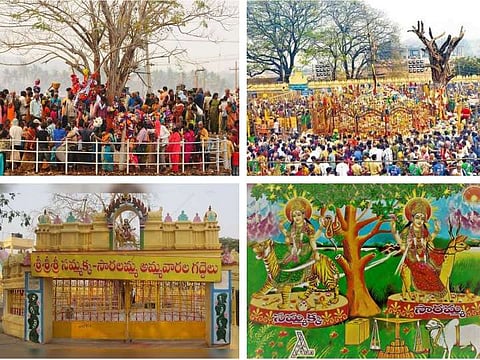

Sammakka Saralamma Jatara or Medaram Jatara... Asia’s biggest tribal mela. It has 1000 years old history. Popularly known as 'Mini Kumbh Mela', the four-day festival draws around two crore devotees from across Telangana, Andhra Pradesh, Chhattisgarh, Odisha, Madhya Pradesh, Bihar, Jharkhand, and Maharashtra. Various tribal sects - Gond Raj Gond, Koya, Gothi Koya, Chenchu, Nayakpodu, Muriya, Mariya, Banjara, and Lambada, among others will take part. Devotees camp in open lands and fields near the temple and gather for four days. Tribal believe that during the Jatara, the goddesses of the forest visit that locality to bless the children of the forest.
Koya Priests Perform Puja
As a state festival, the biennial Jatara will be organized by the Endowments Department of the Telangana state government in the thick forest of Medaram from February 21 to 24. On the day of Maagha Shudda Dwadasi, the tribal Pujaris (Priests) who belong to the KOYA sect of the Adivasi Tribe bring two wooden statues of deities from the thick forest to the temple of Sammakka and Saralamma. There is a small temple in the Medaram, which is located in Tadwai Mandal in Mulugu district (Erstwhile Warangal district). This is a remote place in the Eturunagaram Wildlife Sanctuary, a part of Dandakaranya, the largest surviving forest belt in the Mulugu.
Sammakka – The Savior of Tribes
This festival commemorates the 'Adivasi Veera Nari' Sammakka and Saralamma. The mother and daughter, fights with the reigning rulers against an unjust law. Tribal belief about the miraculous powers of Sammakka. As per the history of the 13th Century, tribal hunters found a newborn baby girl playing amidst cruel tigers. She was taken to their habitation, and then the tribal chief adopted her. Later she becomes the savior of the tribal of the region. She was married to Padigidda Raju a feudatory tribal chief to Kakatiya rulers of Orugallu dynasty, now Warangal (1000 to 1380 AD). Sammakka was blessed with two daughters and one son namely Saralamma, Nagulamma, and Jampanna respectively. People other than tribal devotees also visit the temple and offer prayers to the goddesses during the biannual Jatara days.
Jaggery- Offering as the Prasadam
Before taking the darshan of the deities, Sammakka and Saralamma, devotees have a holy dip in the Jampanna Vagu. It is a tributary to the river Godavari. According to the history, Jampanna was the tribal warrior and the son of tribal goddess Sammakka. The Jampanna vagu (river) took his name as he died in a battle fighting against the Kakatiya Army in the stream. A very interesting ritual is that devotees offer Jaggery, also called Prasadam or Bangaram-Gold (devotees take equaling weight of themselves) during the prayers at the temple.
During the four days Mela, the surrounding forest area was filled with the public, bullock carts, and motor vehicles. Queues would be stretched beyond 10 kilometers. Politicians, officials, and tribal leaders from Telangana and neighboring states will come for the darshan of tribal goddesses. VVIPs, including the Chief Minister of Telangana, other Cabinet colleagues, and senior officials are likely to attend the Jatara.
