
Most of Hindu Largest Temples reside in TamilNadu. Tamil Nadu has a long history that dates back thousands of years, and it has been a center of various dynasties and kingdoms, including the Cholas, Pallavas, Pandya, Nayaka and others. These rulers patronized the construction of temples as a symbol of their power, devotion, and architectural excellence. The temples of Tamil Nadu are examples of the Dravidian school of architecture.South Indian temples have a more ornate and towering entrance gopuram, a rectangular layout, and a single sanctum. As per the Tamil Nadu Hindu Endowments Board, there are 390,615 temples. In this article we are going to know some most famous temples in TamilNadu.
Brihadeeswarar Temple
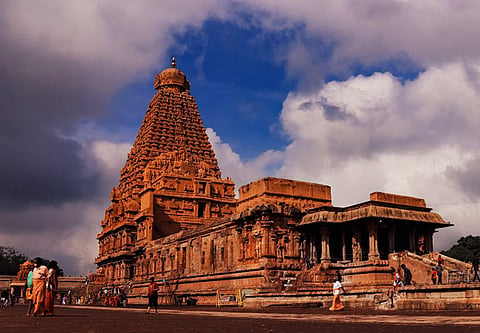
Brihadeeswarar Temple also Known as the 'big temple' is located in the Thanjavur district. The Temple is dedicated to Lord Shiva and is amongst one of the largest temples in the country yet the shadow of the temple surprisingly never falls on the ground at noon. It's said that it has been designed in such a manner that it does not cast a shadow at noon during any part of the year.
The Architecture
The Temple was Built in the year 1010 CE by Chola emperor Rajaraja I. The temple tower is 216 ft long, It was considered as the tallest temple tower in the world. The Brihadeeswarar Temple is a prime example of Dravidian architecture, characterized by its towering vimana (temple tower-weighing 80 tonnes carved from a single granite), mandapa (pillared hall), and intricate sculptural embellishments. The Brihadeeswarar Temple is acclaimed for being the world’s first temple completely built from granite also With no granite quarry within 100 km.
Plus, Beyond the gopuram is the Nandi mandapa, a later addition to the temple. Built by the Nayaka rulers, it houses the massive monolithic Nandi (mount of Lord Shiva) almost 12 feet high and 8 feet wide. The ceiling of the Nandi mandapa is ornately decorated with paintings of the Nayaka rulers.
There is no way to stop admiring the temple’s architecture and mysterious designs. Still there is no proper Explanation of How could the Chola emperor Rajaraja I built the temple?
Temple Active Timings – 6:00am to 12:30pm and 4:00 to 8:30pm.
Meenakshi Amman Temple
Meenakshi Amman Temple is located in the city of Madurai, Tamil Nadu, the temple has a great mythological and historical significance. In the Temple, Goddess Parvati in the form of Meenakshi and her consort, Lord Shiva in the form of Lord Sundareswarar. The present structure of the temple dates back to the 16th century when it was again restored to its pristine glory by the Nayak rulers. According to historical and archaeological records, the temple was originally built around the 6th century AD and the major portion of it was damaged in the 14th century by the Muslim invaders.
The Architecture
The temple was built by Pandyan Emperor Sadayavarman Kulasekaran I (1190 CE–1205 CE). This temple is also a masterpiece of Dravidian architecture. The richly sculptured and decorated ‘Gopurams’ of the temple are its major highlights. The temple complex has 4 nine-storey gopurams (outer, raja), 1 seven-storey gopuram (Chittirai), 5 five-storey gopurams, 2 three-storey, and 2 one-storey gold-gilded sanctum towers. Of these five are gateways to the Sundareshvara shrine, three to the Meenakshi shrine.
Temple Active Timings - 04:30 am to 12:30 pm and 04:00 pm to 08:00 pm
Adi Kumbeswarar
The temple of Adi Kumbeswarar is located in the center of Kumbakonam. This temple is considered to be the 26th Paadal Petra Sthalam in the Chola kingdom that spread south of the River Cauvery. Devotees from all over the world take bath in the Potramarai tank during Mahamaham festival and it is only celebrated once in every 12 years. The Linga is broad at the bottom and narrows at the top in the shape of a needle and Goddess Manthrapeeteswari Mangalambika is his consort and her shrine is situated to the left of the Kumbeswarar shrine. The unique feature of this temple is the 27-star sign and 12 sun shines that are sculptured in a large block of stone. Lord Ganapati, Lord Muruga, and Kiratamurti are the other shrines present at this temple.
The Architecture
The temple was built during the Chola dynasty in the 9th century, while later expansions are attributed to Vijayanagara rulers of the Thanjavur Nayaks of the 16th century. The Kumbeswarar Temple is an architectural marvel which reflects the typical Dravidian architecture and it covers an area of about 4 acres. This temple consists of three Prakaras and three Gopurams. The East Gopuram comprises 9 stories with a height of 128 ft. There are small Gopurams in the north and west and the Mottai (domed-bald) Gopuram in the south.
Temple Active Timings – 6:00am- 12:30pm and 4:00pm – 9:30pm
Ranganathaswamy Temple
‘Ranganathaswamy Temple’ is located on the Srirangam Island of the Tiruchirappalli city. It's one of the most famous Vaishnava temples reclining in the form of Hindu deity, Lord Vishnu. Counted as the first amongst the 108 ‘Divya Desams’ or holy abodes of Lord Vishnu, the temple draws countless pilgrims
The Architecture
The temple was built by Thirumalaraya in 894 AD, a vassal of the Ganga dynasty. It is also another masterpiece of Dravidian architecture. Spread across an area of over 150 acres, the temple has 49 sub-shrines and is dotted with 21 brilliantly carved Gopurams. The ‘RajaGopuram’ stands tall at 236 ft. making it the tallest Gopurams in Asia. The temple also has 7 prakaras. The tower above the innermost prakara is in the shape of ‘Om’ and is completely plated in Gold.
Temple Active Timings – 6:00- 12:00pm and 6:00pm to 9:00pm
Rajagopalaswamy temple
Mannargudi is known for the Rajagopalaswamy temple, a prominent Vaishnavite shrine of Lord Vishnu. Located in the town of Mannargudi. The temple is also known as Guruvayoor by Hindus. It is one of the most popular vaishnavite temples in India. The main sannidhi of the temple displays 32 forms of Lord Krishna. According to a legend Lord Krishna gave darshan to two sages Paravasudeva and Raja Gopalan in 32 forms. Sri Rajagopalaswamy Temple is dedicated to Rajagopalaswamy, an incarnation of Lord Vishnu. The sanctum of the temple enshrines Vaasudeva with his consorts Sri Devi and Bhoodevi. The Utsava murthi idol is of exquisite beauty and is adorned with precious jewellery and colourful flowers. Along with him are his consorts Rukmani and Satyabhama.
The Architecture
The temple was first constructed by Kulothunga Chola I in the 10th century and Chola Kings Rajaraja Chola III, Rajendra Chola III and later expanded by Thanjavur Nayaks during the 16th century. 7 feet high image of Vaasudeva with his consorts. The temple has 16 gopurams, 18 Vimaanas, 7 Prakarams, 7 Mantapas.Sri Devi and Bhoodevi are the consorts of Lord Vishnu. The temple has 16 gopurams, 18 Vimaanas, 7 Prakarams, 7 Mantapas.
Temple Active Timings - 6:30am to 12:00 pm and 4:30pm to 9:00pm
