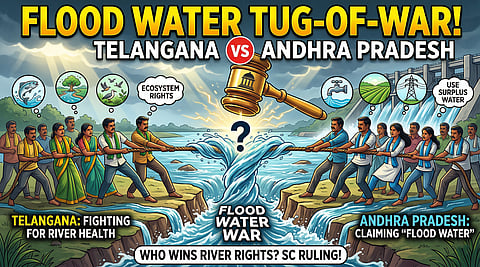

The Supreme Court is facing a tough question: who actually owns flood water? It all started because Telangana is challenging Andhra Pradesh’s Polavaram-Banakacherla Link Project. Telangana says the project breaks the rules set by the Godavari Water Disputes Tribunal. Andhra Pradesh argues they’re just using surplus water that would otherwise spill into the sea unused. Telangana disagrees, saying this approach messes up the whole basin’s water-sharing arrangement. This battle isn’t just about these two states—what the court decides could shape the future of inter-state river disputes right across India.
Picture a heavy rainstorm swelling a river until it bursts its banks. One person sees the extra water as wasted, vanishing into the ocean. Someone else views it as essential for the river’s ecosystem—not just water, but the force that keeps the delta alive and flourishing.
This tension sits at the core of India’s Supreme Court showdown, where Andhra Pradesh and Telangana face off over the Polavaram-Banakacherla Link Project. The court isn’t only sorting out a technical pipeline. It’s wrestling with the fundamental question: who gets to claim rainwater?
Project Sparking the Battle
Andhra Pradesh wants to divert water from the Godavari basin (thanks to the Polavaram project) down to the Banakacherla cross regulator. Their logic? During monsoon season, a staggering volume spills out to sea. They say grabbing this so-called "flood water" to help dry Rayalaseema is practical and fair.
Telangana disagrees. They cite the Godavari Water Disputes Tribunal’s strict rules and worry that once Andhra builds permanent channels for "flood water," it won’t just stick to monsoons. Drawing water all year would leave Telangana’s own projects in trouble.
Is Water Really "Surplus"—or Essential?
This fight isn’t just about legal rules. It boils down to the idea of "waste." For years, engineers believed any water reaching the sea meant poor management. But environmental science has flipped the script.
Floodwaters aren’t just runoff:
They flush the delta, keeping saltwater at bay and protecting coastal aquifers.
They carry silt, vital nutrients for downstream farms.
They trigger fish breeding cycles, blending river and ocean waters.
If the Supreme Court rules that anyone can claim "surplus" water first, it risks setting off construction frenzy—giant projects popping up everywhere, threatening river mouths and ecosystems.
A Ruling That Echoes Across India
This is bigger than Andhra Pradesh and Telangana. River disputes are a recurring headache, from the Cauvery’s southern reaches to the Yamuna up north, destabilizing India’s federal system.
If Andhra wins, it legitimizes "surplus water" grabs nationwide. If Telangana wins, it affirms the principle that rivers should be managed start-to-finish, regardless of state lines.
Turning Rivalry Into Shared Stewardship
It’s clear the answer isn’t picking a winner. The Supreme Court could push for Real-Time Data Sharing and oversight. With automated sensors, states can measure the water—no more wrangling over old estimates. True flood events, verified in real time, would trigger controlled diversions under a central authority. As unpredictable monsoons become the norm thanks to climate change, treating water as a trophy is reckless. We need to start thinking of rivers as collective national assets. The outcome of this case matters, not just for Andhra and Telangana, but for everyone. Water’s value now rivals gold—and today, the world is watching India’s response.
