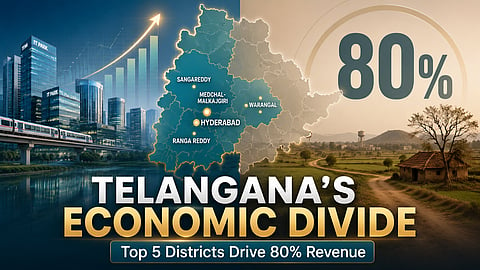

Telangana’s economy is booming, but most of the action is concentrated near Hyderabad. If you look at recent financial data, the gap between rich and poor regions couldn’t be clearer: while Hyderabad and its surrounding districts are breaking national records, much of rural Telangana is left behind.
Wealth Magnets: Top 5 Districts
Districts driving the state's economy are:
· Ranga Reddy (IT and Real Estate hub)
· Hyderabad (IT, Services, and Business center)
· Medchal-Malkajgiri (Industrial corridor and rapid urbanization)
· Sangareddy (Pharma and Manufacturing)
· Warangal (Emerging commercial hub)
Ranga Reddy district isn’t just the wealthiest in Telangana—it’s one of the richest in the country, with a per capita income topping ₹11.46 lakhs. Along with Hyderabad, Medchal-Malkajgiri, Sangareddy, and Warangal, these five districts form the state’s economic backbone. Ranga Reddy leads as an IT and real estate powerhouse. Hyderabad is known for IT, services, and business. Medchal-Malkajgiri stands out as an industrial zone, while Sangareddy thrives in pharma and manufacturing, and Warangal is gaining momentum as a commercial hub.
Here’s the real kicker: These five districts generate nearly 80% of Telangana’s total tax revenue. It makes sense—corporate headquarters and big city consumers sit here, and since GST is based on consumption, wealthier areas pump much more money into state coffers.
Revenue Breakdown (2025-26 FY)
Looking at the 2025-26 financial year, the numbers reflect strong growth. Despite concerns over central GST slab reforms, Telangana didn’t just hold steady—it grew, hitting a healthy 5% overall uptick. GST collections alone jumped by 8.1% in the second half of the year, with monthly intake ranging from ₹3,459 crores in December to ₹4,230 crores in March. To put things in perspective, GST contributed ₹44,450 crores, liquor VAT brought in ₹16,942 crores, and petroleum added ₹16,346 crores.
Ground Reality: Struggling Rural Districts
Reality it clear, while tech corridors flourish, rural districts like Narayanpet, Mulugu, Jayashankar Bhupalpally, and Kumuram Bheem Asifabad are barely on the map, adding just 1% to 2% to the state’s tax pool. Why do these places lag behind? They depend almost entirely on agriculture, with little footing in manufacturing or services. Infrastructure is weak—roads and basic facilities are lacking, so new industries rarely venture outside the capital region. IT and other major service sectors remain stuck in Hyderabad, making the growth of Tier-2 cities frustratingly slow.
Way Forward: Need for Decentralization
How does Telangana close this gap? Experts say the state needs to decentralize economic growth. That means moving IT and service industries to other cities like Warangal, Karimnagar, Nizamabad, Nalgonda, and Khammam—places that, with the right push, could see a boom in local purchasing power. Supporting micro, small, and medium enterprises with special incentives can spark industrial growth even in villages. And every district needs to focus on building value—whether that’s exporting local goods or nurturing new auxiliary industries—to boost revenue. If the government sticks to the current Hyderabad-focused approach, the economic divide between urban and rural Telangana won’t shrink. It’ll get wider.
