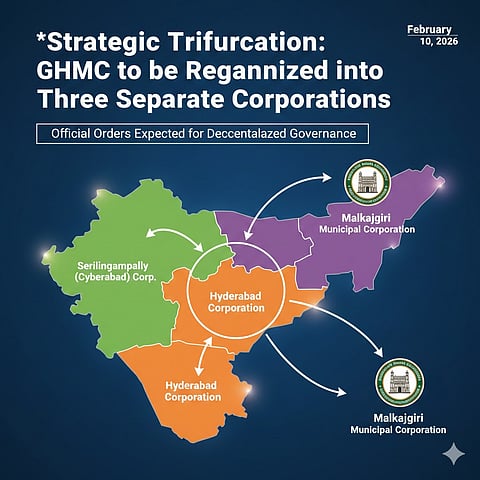

The Telangana government has decided to shake up urban governance. They’re moving forward with a plan to split the Greater Hyderabad Municipal Corporation (GHMC) into three new corporations. This isn’t just a proposal anymore—official orders will land on February 10, 2026, right as the current GHMC Council’s five-year term wraps up.
This is a big shift for Hyderabad. Not long ago, the government expanded GHMC by merging with 27 nearby municipalities, briefly making it India’s largest civic body. That era is over. Now, the focus is on making administration more manageable and getting things done faster.
How Will This Work?
The city will see the GHMC split into three corporations, each mapped to the boundaries of a police commissionerate. The idea is simple: when law enforcement and civic officials share the same turf, coordination gets easier.
Here’s how it breaks down:
Proposed Corporations:
1. Hyderabad Municipal Corporation
Covers: Hyderabad Commissionerate
Key Zones: Charminar, Khairatabad, Secunderabad, Golconda
2. Serilingampally (Cyberabad) Corporation
Covers: Cyberabad & Future City Commissionerates
Key Zones: Serilingampally, Kukatpally, Quthbullapur
3. Malkajgiri Municipal Corporation
Covers: Malkajgiri (formerly Rachakonda)
Key Zones: Malkajgiri, LB Nagar, Uppal
What’s Next: Elections in August
To make all this happen smoothly, the government has already started moving around its senior bureaucrats. The clock is ticking. By law, elections for these new corporations have to take place within six months of their formation. That points straight to August 2026 for Hyderabad’s next big civic polls. But this isn’t just about splitting up a giant civic body—it’s about future-proofing Hyderabad. Bringing the “Future City” area under Serilingampally shows where the government’s attention is: tech corridors, high-growth spots, and the next wave of development.
Expanding the GHMC to the Outer Ring Road (ORR) was supposed to bring even development across the city. But with the GHMC now sprawling over 2,053 square kilometers, the administrative load got out of hand. Breaking it up brings clear benefits:
Smaller corporations respond faster. Whether it’s fixing roads, sorting out water supply, or cleaning up, things get done quicker when the area is manageable. Each corporation can focus on what matters to its people—preserving history in the Old City, or building tech infrastructure in the west. With separate budgets, it’s easier to track revenue and spending for each unit. When the government issues its order on February 10, it’ll mark the end of the all-in-one GHMC era. Hyderabad will step into a new chapter: three cities, one metropolitan heartbeat.
