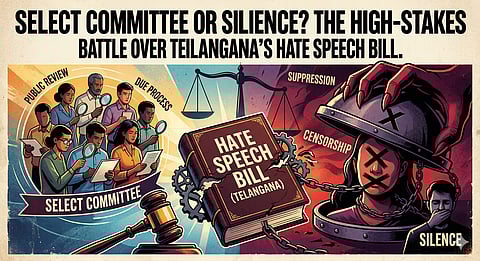

In a rare move for Telangana politics, the Legislative Assembly decided Monday to hand the contentious Telangana Hate Speech and Hate Crimes (Prevention) Bill, 2026 over to a Select Committee. Tempers flared as opposition lawmakers—and even some voices from within the ruling Congress—challenged the bill’s sweeping language, insisting it threatens to tip the balance between keeping order and protecting freedom.
Minister Ponnam Prabhakar, representing Chief Minister Revanth Reddy, introduced the bill, describing it as a response to spikes in provocative content swirling on social media. But instead of calm, the proposal triggered the very discord it claims to prevent: a fierce argument over whether the law serves as a shield against communal violence or simply gives the government new powers to muzzle dissent.
"Death Warrant" for Democracy?
The BJP came out swinging. MLA A. Maheshwar Reddy called the bill a “death warrant to democracy,” accusing lawmakers of writing definitions of hate speech so broad that even historical critique could land you in trouble. For example, the bill criminalizes speech that causes “ill-will against a person, alive or dead.” Critics say this leaves the door open for prosecuting anyone who comments on past rulers or controversial political figures—including those long gone.
Other parties chimed in. BRS Working President K.T. Rama Rao warned the law could be twisted to target journalists and critics, conveniently labeled as disruptors of social harmony. CPI MLA Kunamneni Sambasiva Rao zeroed in on an especially controversial clause—one that allows authorities to hold entire organizations or political parties responsible for one member’s remarks. He dismissed it as flatly “unreasonable.”
Stringent Penalties and Police Power
When you look at the draft bill, the penalties jump out. Hate speech isn’t just a regular offense; it’s both cognizable and non-bailable. The state proposes strict sentencing:
First-time Hate Crime - 1 Year to 7 Years jail and potential fine up to Rs 50,000
Repeat Offense - 2 Years to 10 Years jail and potential fine up to Rs 1,00,000
The bill goes further. It empowers a “designated officer” to order service providers or intermediaries to block or remove content online. And an “immunity clause” shields officials from lawsuits, as long as they act “in good faith.”
Ruling govt’s Balancing Act
Chief Minister defended the initiative, arguing that existing laws—including the Bharatiya Nyaya Sanhita—simply can’t cope with the speed and reach of digital abuse. Supporters like Congress MLA Danam Nagender say people now hide behind freedom of speech to spread abuse and provoke unrest, putting the social fabric at risk.
What about Art-19 of the Constitution?
Sending the bill to a Select Committee effectively pauses everything. It's a smart maneuver: the government avoids a deadlock, buys itself time, and signals some willingness to rethink or revise the most controversial parts. So what’s next? The Select Committee will pore over the definitions of “hate speech” and “hate crimes,” aiming to keep the law consistent with Article 19’s free speech protections. Legal observers expect the committee to tighten up language around “ill-will” and the “intent to cause injury,” guarding against abuses of power by the police. The real question now: Can Telangana craft a law that mutes the trolls without gagging ordinary citizens? Everyone’s watching to see if this legislative pause leads to real balance or just buys the government more time amid controversy.
