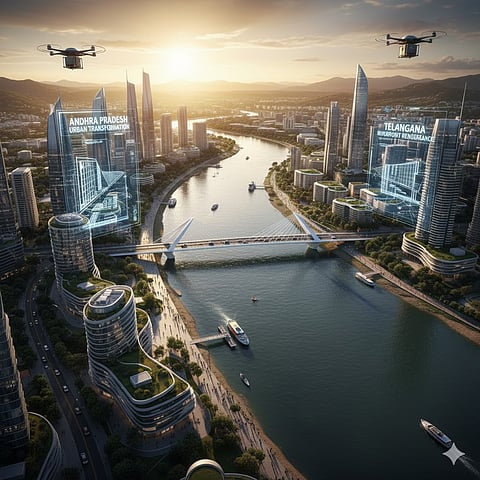

Andhra Pradesh and Telangana aren’t just dreaming about better cities—they’re going all in, betting big on their rivers to fuel the next era of urban living and tourism. Andhra Pradesh wants to give the Krishna River in Vijayawada a Marina Beach-style makeover, while Telangana is taking notes from Seoul, hoping to turn the Musi River into something as lively as the Cheonggyecheon stream.
A Tale of Two Rivers, Two Visions
Start with Andhra Pradesh, Chief Minister Chandrababu has his eye on something grand—a Krishna riverfront that could rival the buzz and scale of Chennai’s famous Marina Beach. This isn’t just another city park. He’s thinking bold: a 20-30 km stretch with a striking A-shaped cable-stayed bridge as a new city symbol, water taxis zipping along the river, floating restaurants, adventure sports, and luxury living. Projects like the Alakananda Riverfront are already laying the groundwork for upscale communities and major tourism infrastructure.
Over in Telangana, Chief Minister Revanth Reddy is moving fast on the Musi Riverfront Development Project. He wants to clean up what’s now a polluted channel and revive it as a flowing, perennial river—echoing Seoul’s transformation of the Cheonggyecheon. The first phase, a 21 km stretch from Osmansagar to Bapughat, is set to open by Ugadi 2026. They’re planning a 150-foot Mahatma Gandhi statue, a world-class museum, and “night economy” zones with waterfront cafes and pedestrian promenades.
What’s at Stake: Money, Jobs, and the Shape of the Cities
If these projects land as planned, they could change the economic game for both states. Riverfront properties always draw a premium—20-30% higher, usually—so Vijayawada and Hyderabad expect a real estate surge, attracting top-tier investors for both homes and businesses. Both cities are also zeroing in on tourism, designing spaces made for selfies and skyline shots, aiming to rake in visitors and create thousands of jobs in hospitality and services. But there’s more than just glamour shots. Each project requires sprawling sewage treatment networks to clean up the water and give the local climate a boost. It’s urban renewal with an environmental backbone.
Big Dreams, Big Obstacles
None of this comes easy. The price tags are steep. Telangana’s Musi project alone runs between ₹29,000 and ₹50,000 crore. The Asian Development Bank is interested in offering a tentative ₹4,100 crore loan, but that’s just the tip of the iceberg. Andhra Pradesh is also scraping for funds, relying on central government support and the Amaravati land-pooling model to make the Krishna vision a reality. Then there’s the human side. Both states face pushback from people living along the rivers. In Hyderabad, the Musi Jan Andolan is protesting the eviction of thousands of families from the riverbed. Vijayawada faces its own set of challenges, with dense populations and slums along the canals making land acquisition a tangled, sensitive issue. Ecology adds another layer of complexity. Cleaning up the Musi isn’t just about looking good; it means stopping decades of toxic waste from pharmaceutical industries—a problem that’s beaten planners before. For the Krishna, the puzzle is how to control floods and keep water levels steady behind the Prakasam Barrage without hurting farmers downstream.
Where It All Leads?
These riverfront projects signal a new kind of city planning—one that puts experience and beauty front and center, not just function. If Andhra Pradesh and Telangana pull this off, Vijayawada and Hyderabad could join the ranks of the world’s great waterfront cities. But the road is tough. High debt looms, and the challenge of marrying urban beauty with justice for the people living along the rivers is far from solved.
