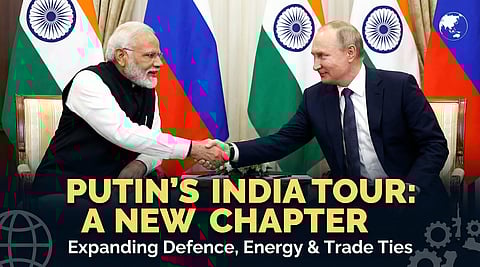

Russian President Vladimir Putin’s high-stakes trip to India wasn’t just another diplomatic photo op—it felt like a turning point. With the world’s eyes glued to every handshake and headline, the visit landed right in the middle of shifting alliances and ongoing conflicts.
As Prime Minister Modi greeted President Putin, he didn’t mince words: “We should work together and pave the way for peace.” That line set the stage for what came next—talks that ran deep, touching everything from military cooperation to energy deals. Putin-Modi meeting set the tone for what could be a pivotal new era in India-Russia relations. The two leaders didn’t just exchange formalities. They got straight to business, addressing topics from defence and energy to trade and security at a moment when global alliances are in flux. Mainly, India emphasized its commitment to strategic autonomy, maintaining its independent approach despite increasing external pressures.
Key Highlights of the Tour
New defence agreements, though they kept most details under wraps. Reliable leaks hint at joint production of military gear and technology transfer, which only makes India’s role as a top Russian arms partner even stronger. Energy was right up there too. Both sides agreed to look for new sources of oil and gas, and it looks like Russia’s share in India’s energy market is about to get a boost, possibly through fresh long-term contracts.
But the talks didn’t stop at tanks and pipelines. Modi and Putin zeroed in on trade—figuring out ways to cut through red tape and push for joint ventures in pharmaceuticals, infrastructure, even digital tech. Security came up, too. Both leaders found solid common ground on regional threats, counter-terror efforts, and global cooperation. It’s clear they see the world through a similar lens, at least on the big-picture issues.
Impact on Bilateral Ties
What do all these developments mean for India and Russia? The mood, especially in New Delhi, is triumphant. This visit reinforced a partnership that’s survived decades of change—one built on real trust and shared interests. The new deals promise tighter economic and defence ties, giving both countries a sturdy platform to work from. At the same time, India sent a subtle but unmistakable message: it’s still running its own foreign policy, balancing relationships with the West, Russia, and everyone in between.
Potential Reactions from the US
Of course, Washington isn’t thrilled. The US has tracked every move, and you can bet officials are worried. America keeps pushing India to ease off Russian arms and energy, especially after recent global flashpoints. This visit, doubling down on those ties, will raise eyebrows in Washington DC. Some might see it as undermining efforts to isolate Russia on the world stage. There’s also the CAATSA problem—the US law that threatens sanctions on countries buying Russian defence tech. India has dodged that bullet before, but the scale of these new agreements could spark another round of heated debates among US lawmakers. The US sees India as a critical player in its Indo-Pacific strategy, hoping to counter China’s rise. If India and Russia get even closer, especially in defence, that could complicate things for Washington. Still, don’t expect any drastic moves just yet. The US will likely keep up the friendly pressure, highlight shared democratic values, and quietly try to pull India a bit closer to the Western fold.
Finally, Vladimir Putin’s India tour stands out as a milestone. It cements a long-term partnership, even as the global chessboard gets more crowded and unpredictable. The real impact—on both India-Russia relations and the wider world—will unfold in the months ahead.
