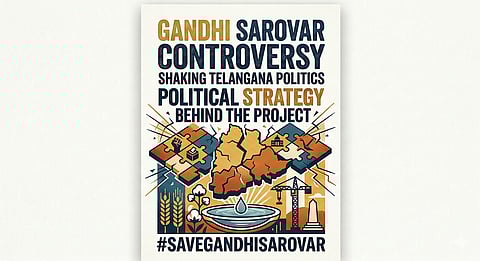

“Gandhi Sarovar” and world’s biggest “Mahatma Gandhi Statue”…What started as a sweeping vision from Revanth Reddy’s government has exploded into one of the hottest political battlegrounds in Telangana. The Gandhi Sarovar Project—Rs 5,000 crore for a grand new water-body on the Musi River, topped off with the tallest Mahatma Gandhi statue on Earth—was supposed to mark a new era for Hyderabad. Instead, it’s sparked uproar. Residents, opposition parties, civil society groups, and even Gandhi’s own family are pushing back. At its heart, the fight is about more than just a statue. It’s a question: Can a government’s dream of nation-building coexist with the messy realities of social justice and the threat of mass displacement?
As eviction notices meet Gandhian philosophy debates, Telangana’s political discourse is increasingly shaped by a paradox — a project built in Gandhi’s name now being judged by Gandhi’s principles.
Big Dreams, Bigger Statements
Gandhi Sarovar isn’t just about beautification. It’s part of the Musi Riverfront plan—a shot at turning neglected riverbanks into a showpiece for culture and tourism. Here’s what’s on the table:
- A huge artificial lake (“Sarovar”) near Bapu Ghat
- A 500-foot statue of Gandhi—no other in the world comes close
- Public plazas, memorial spaces, tourist zones
- Cleaning up and restoring the riverfront
Officials talk about civilizational pride and global heritage status. Telangana, they say, will become home to the world’s largest Gandhi memorial, a beacon for tourists. They promise jobs, urban renewal, and a living tribute to Gandhian ideals.
On the Ground: Fear, Uncertainty, and Anger
If we talk to people living near the site and the mood shifts fast. Residents—whether in apartment blocks or informal settlements—say eviction notices are already landing at their doors. The reason: river buffer expansion and land grabs. Families are in the dark about compensation, where they’ll go, or how they’ll survive the upheaval. Protests have grown louder, especially near Bapu Ghat, as demolition rumors spread. Hundreds of families could be pushed out. For many, it feels like a battle between fancy city plans and the daily struggle to get by.
“Development can’t just wipe out communities,” protest organizers told reporters. Middle- and lower-income families are scared—rightly so.
Opposition leaders have seized on these fears, accusing the government of choosing flashy projects over people’s homes.
Gandhi’s Grand-son Steps In
The controversy hit a new peak when Tushar Gandhi, Mahatma Gandhi’s great-grandson, publicly condemned the project. He called it “ego-driven,” “anti-Gandhian,” and out of step with Gandhi’s values of simplicity and justice. In his words, spending thousands of crores while uprooting citizens is a betrayal of everything Gandhi stood for. He’s even threatened protests if the government presses ahead. Suddenly, the Congress government is facing heat from the very family whose legacy they claim to honor.
Politics: When everyone’s Against You
One thing the project has done: it’s united the opposition. BRS leaders accuse the Congress government of putting “monumentalism over welfare.” They want the national Congress to step in and stop the evictions. The BJP leaders said- “They’re for cleaning up the river, but not at the cost of the poor”. Telangana Saffron leaders are demanding a stop to demolitions and say development shouldn’t mean driving out the vulnerable.
Fight is now a Full-blown Political Crisis
Controversy turns into a serious environmental angle. Urban planners and activists aren’t staying quiet either. Their list of worries runs long:
- Where are the transparent environmental impact reports?
- How will this affect the river’s ecology and floodplains?
- Does a massive memorial actually help restore the river—or just dress it up?
- Is tourism taking priority over real, sustainable solutions?
They argue that real river rejuvenation starts with ecology, not monuments. The government, they say, has it backwards.
Money Matters: Welfare or Prestige?
All this comes with a hefty price tag—Rs 5,000 crore. Critics say the money would do more good if it went to welfare, housing, city infrastructure, or jobs. Supporters reply that big projects like this bring long-term growth and put Hyderabad on the world map, just like other giant statues have done for tourism elsewhere. So, the debate boils down to this: Should the state chase short-term welfare, or invest in long-term prestige? For now, the answer is anything but clear.
Political Strategy behind the Project
The Gandhi Sarovar initiative isn’t just another development project for the Congress government. At its core, it’s political — a move to reclaim Gandhian symbolism and draw a clear line between themselves and rivals like the BJP and BRS. It’s an early attempt to put their stamp on urban governance, to show that they can launch big, transformative projects right out of the gate. They’re also trying to change the narrative: instead of being stuck dealing with old fiscal messes and broken infrastructure, they want people talking about bold, visionary development. But there’s risk here. The very symbolism Congress leans on now threatens to work against them. Critics call it performative nationalism — all show not real, inclusive progress.
Public Sentiment: Fractured and Growing
On the ground in Hyderabad, opinions are all over the place. Among affected residents, fear of displacement dominates. They want straight answers, not slogans. The urban middle class feels torn — there’s pride in a landmark, but worries about costs and priorities. Political activists… they’re deeply divided, no surprise there. Heritage supporters mostly back the idea of a global Gandhi memorial. What’s really fueling unrest is the lack of concrete promises about rehabilitation. People want to know what happens to them, not just what happens to Gandhi’s memory.
The Larger Question
This fight isn’t just about a statue or a lake anymore. It’s tangled up in a bigger question Indian cities keep facing: Should leaders chase after giant, identity-defining symbols, or focus on steady, people-first reforms that actually change lives? For Chief Minister Revanth Reddy, the Gandhi Sarovar project stands at a crossroads. It could end up as his defining legacy, something people point to like the country’s major monuments. Or it could become a lesson in how top-down development clashes with the needs of regular people.
Now, as eviction notices spark heated debates about Gandhian values, Telangana’s political conversation has grown more complicated. There’s irony in this — a project built in Gandhi’s name, now measured against the very ideals he stood for.
