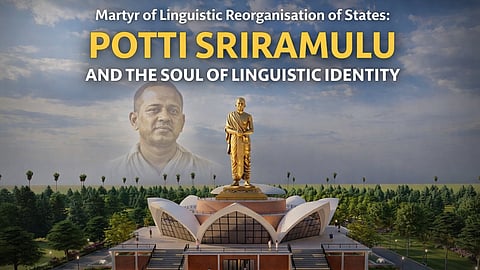

A new figure towers over Amaravati’s skyline—the “Statue of Sacrifice.” It’s huge and unmissable, dedicated to Potti Sriramulu, the man whose 58-day hunger strike in 1952 didn’t just tilt the borders on a map; it rewrote the idea of what India could be. Staring up at that statue, you can’t help but think about the birth of modern India all over again. The British left behind a big territory, sure, but it was people like Sriramulu, and the purity of their commitment, who turned it into a federation full of lively, distinct cultures.
A Devotee of Truth and Action
Sriramulu wasn’t some rabble-rouser after power or fame. He was a Gandhian through and through. He left a steady job at the Great Indian Peninsular Railway, joined the Independence movement, and lived years at Sabarmati Ashram. Gandhi didn’t hand out praise lightly, but he once said, “If I had eleven more like Sriramulu, I could win freedom in a year.” For Sriramulu, activism wasn’t about breaking things apart; it was about dignity. Telugu speakers in the Madras Presidency made up a massive group, but after independence, they kept feeling invisible—outnumbered by the colonial legacy, boxed in under the control of Tamil leadership with Madras as the center.
Ultimate Sacrifice: 1952
By 1952, pressure for a separate Andhra state had reached its breaking point, but the central leadership under Nehru refused to budge. They thought creating states by language would just split the country apart, so they dragged their feet.
On October 19, 1952, Sriramulu started his fast-unto-death in Madras. His demands were clear and steadfast: create an Andhra state, and bring Madras city into it—Madras being a hotly contested prize.
The days crawled on, Sriramulu grew weaker, but the movement only grew stronger. Nehru held his ground, brushing the protest aside. But on December 15, the 58th day, Sriramulu died. The shock ignited mass protests all over Telugu-speaking regions. Four days later, the government, shaken and finally listening, declared the birth of Andhra State.
Domino Effect: A New India
Potti Sriramulu’s sacrifice was like a tectonic jolt—suddenly, language wasn’t something you could flatten just to make administration easy. People wouldn’t have it.
On October 1, 1953, Andhra State was born, with Kurnool as its capital—the first time a state formed just for the sake of language. That kicked off the States Reorganisation Commission the same year, as similar demands flared up everywhere. Then, on November 1, 1956, the States Reorganisation Act took hold. Fourteen states and the six union territories, all now mostly drawn along linguistic lines.
States like Maharashtra and Gujarat emerged from old Bombay State. Punjab and Haryana split later. The Northeast keeps shifting. All of these, in one way or another, trace their own histories back to Sriramulu’s 58 days of resolve in 1952.
“Statue of Sacrifice”: Why It Matters Now?
The new statue in Amaravati is more than a showpiece. Andhra Pradesh knows what it’s like to split—think back to the split with Telangana in 2014. Still, Sriramulu stands as the state’s figure of unity. These days, “oneness” sometimes gets confused with “sameness,” but Sriramulu’s memory tells us that India’s real power comes from its many layers. He taught the Republic early on that recognizing someone’s mother tongue isn’t threatening; it’s about belonging. That hunger strike in 1952 was a cry—a demand for respect, a chance to be heard. Today, as Amaravati rises, it does so in the shadow of a man who refused to let the Telugu identity fade away. Sriramulu’s sacrifice ensures that, inside the democracy he fought for, the Telugu voice can’t be drowned out.
