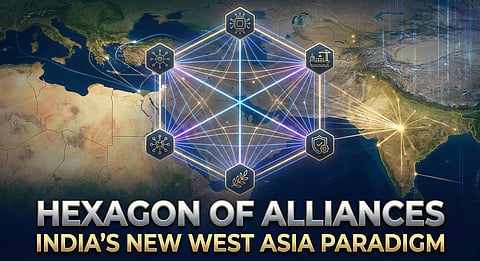

Prime Minister Narendra Modi is scheduled to begin his historical two-day visit to Israel on February 25, nine years after his first trip to the country. Modi to land in Tel Aviv for his second visit—one that feels a lot weightier than his first. His 2017 trip was the first ever by an Indian prime minister to Israel. Earlier trip marked a big shift: India stopped treating its ties with Israel and Palestine as a package deal. This time, though, the stakes are much higher. Modi isn't just coming to celebrate old victories. He’s stepping right into the heart of what Benjamin Netanyahu is now calling a “Hexagon of Alliances”—an ambitious new setup meant to reshape the Middle East and pull India deep into its core.
A New Shape in the Region
Just before Modi’s arrival, Netanyahu laid out his idea for moving past the old, one-on-one alliances. This “Hexagon” brings together India, Israel, Greece, Cyprus, and a handful of Arab and African partners into what he calls an “axis of stability.” For Netanyahu, it’s a shield—something to hold off Iran’s Shia influence and rising Sunni radicalism. For Modi, it’s the clearest proof yet of India’s “Extended Neighborhood” policy really taking off. India isn’t just buying Israeli defense tech anymore. Now, it’s being cast as the eastern anchor of a new West Asian security and economic order.
IMEC and the “Plus” Factor
The timing here is no accident. By February 2026, the India-Middle East-Europe Economic Corridor (IMEC) is finally moving out of the planning stage. Sure, regional conflicts slowed things down, but recent deals—like Adani Ports teaming up with Marseille Fos and this new “IMEC Plus” idea that brings Africa into the mix—show the corridor is becoming the backbone of these alliances. Netanyahu isn’t hiding the main agenda either. This visit is all about AI and quantum computing. In 2026, these aren’t just buzzwords—they’re vital for national security and survival.
The Trump Wildcard
There’s also the Trump factor. With Trump back in the White House, Netanyahu’s close ties with both him and Modi suddenly matter even more. That personal chemistry could finally jump-start regional projects that have been stuck in neutral for years.
Walking a Tightrope: Jerusalem and Beyond
Still, Modi’s trip won’t be all handshakes and headlines. In Israel, his visit has become a political flashpoint. The opposition has threatened to boycott his Knesset speech unless the government invites the Supreme Court Chief Justice—a protest against Israel’s long-running judicial crisis. Meanwhile, India has to juggle its strong partnership with Israel against the harsh spotlight of international criticism. With the UN sounding alarms over the humanitarian crisis in Gaza and the West Bank, and New Delhi recently joining statements against West Bank expansion, its clear India isn’t just following Netanyahu’s lead. The “Bibi and Modi” friendship is real, but India is still guided by its commitment to a rules-based order.
“The fabric of this relationship has grown tighter... India is not a small country. It is a gigantic power.” — Benjamin Netanyahu, February 22, 2026
What This All Means: Beyond Old Divides
Modi’s 2026 visit marks a shift. India isn’t just “balancing” anymore—it’s integrating. By becoming a key player in this Hexagon, India is betting that West Asia’s future will be built on economic corridors and cutting-edge security, not the old ideological fights. If this works, it won’t just mean a stack of new agreements. It’ll mark the start of a new reality—one where the Mediterranean, the Ganges, and the Jordan are connected not just by trade, but by a shared vision for a stable, multipolar West Asia.
