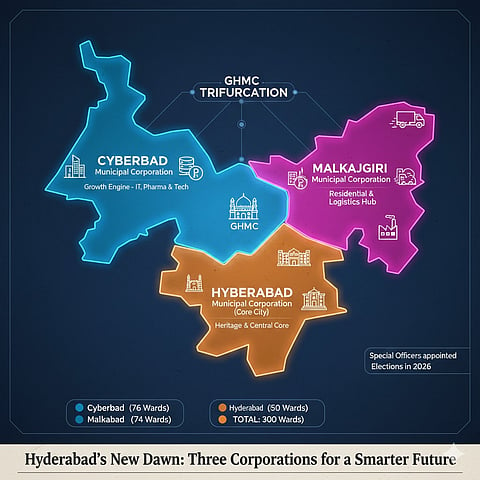

Hyderabad is on the brink of a major shakeup. The Telangana government plans to split the Greater Hyderabad Municipal Corporation (GHMC) into three separate municipal bodies. The goal is to make city administration sharper, bring civic services closer to people, and speed up development in a city that’s outgrowing its current setup. Supporters say this is the route to more nimble, responsive governance. On the other hand, critics worry about political maneuvering and whether resources will really get divided fairly.
Three New Corporations
Hyderabad Municipal Corporation (Core City)
This corporation focuses on the historic core and central business districts. It is the largest of the three in terms of political representation and includes the traditional "MCH" areas along with southern expansions.
Wards: 150 divisions.
Zones covered: Secunderabad, Khairatabad, Golconda, Charminar, Rajendranagar, and Shamshabad.
Key Areas: Banjara Hills, Jubilee Hills, Mehdipatnam, Attapur, and the Airport zone (Shamshabad).
Cyberabad Municipal Corporation (Western Corridor)
Formerly part of the western zones, this corporation is the "Growth Engine" of Hyderabad, housing the IT hubs, pharmaceutical clusters, and high-rise residential townships.
Wards: 75–76 divisions.
Zones covered: Serilingampally, Kukatpally, and Quthbullapur.
Key Areas: Gachibowli, Madhapur, Hitech City, Miyapur, Nizampet, and Jeedimetla.
Malkajgiri Municipal Corporation (Eastern Corridor)
This corporation covers the densely populated residential belts and industrial zones on the eastern side of the city. There is a strong local demand to potentially rename this the "Secunderabad Corporation" or "East Hyderabad Corporation."
Wards: 74–75 divisions.
Zones covered: Malkajgiri, Uppal, and LB Nagar.
Key Areas: Alwal, Kapra, Boduppal, Moula-Ali, Saroornagar, and Hayathnagar.
Why Split the GHMC?
The current GHMC stretches over 625 square kilometers, serving more than 10 million people. One body trying to manage roads, trash, water, and urban planning for all that is not quite possible. It’s a recipe for delays and frustration. The government believes breaking the city into smaller, manageable chunks will make a real difference.
First, smaller corporations mean tighter administration. Officials won’t be overwhelmed and can actually focus on local problems. Decisions happen faster. Second, services—think sanitation, waste management, fixing potholes—should get delivered more efficiently because the people in charge are closer to the ground. Third, splitting the city is supposed to help even out development. No more certain areas getting all the parks and flyovers while others get left behind. And last, with a smaller turf, elected representatives can’t hide. People will have more direct lines to those in charge, which should mean more accountability.
How Will the Trifurcation Work?
Details are still up in the air. We don’t yet know exactly what the three new corporations will be called or where boundaries will fall, but the plan is to divide based on geography and population. Each corporation will get its own Mayor, Standing Committee, and set of officials—running their own show but still following state policies.
There’s a lot to sort out. Assets and debts have to be split up fairly. Staff will need to be reassigned. Money—the lifeblood of any city—will get distributed through new formulas, possibly with tweaks to property tax and more grants from the state government. And while each corporation will do its own thing, there’s an understanding that big infrastructure—major roads, public transit—still needs coordination. So, the city’s planning won’t get completely fragmented.
Politics: The Game Changes
This split will completely redraw the city’s political map. With three mayors and more corporator seats, more local leaders get a shot at real power. Expect serious competition, especially with the ruling party trying to cement its hold over each new area. Local issues—bad drainage, broken streetlights, neighbourhood parks—are likely to dominate campaigns. At the same time, each corporation could start to carve out its own political identity, with new rivalries and alliances emerging.
Faster Progress or New Headaches
From a development angle, the hopes are high. More focused administrations should mean critical projects—roads, flyovers, bus routes—move off the drawing board and into reality faster. Neglected neighborhoods might finally get the attention they’ve been denied. Parks, community centers, and other public spaces could see real upgrades. But splitting the city isn’t a silver bullet. The risk is that one corporation surges ahead while another lags behind. Ensuring that resources, funding, and opportunities are shared fairly will take real effort and oversight from the state. Otherwise, the city could end up more divided than ever. Hyderabad is growing, and so must its governance. Whether this new era delivers on its promise depends on how these changes play out on the ground, not just on paper.
