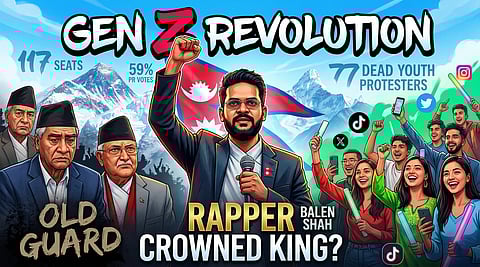

Beneath the peaks of the Himalayas, Nepal’s old political order collapsed—not because of backroom deals or rebel armies, but because a new generation had enough. They brought their anger to the streets, their voices to social media, and their votes to the polls. On March 5, 2026, people all over this rugged country dipped their fingers in ink and marked ballots, still haunted by the memory of last September’s deadly youth protests. Back then, the streets were stained with the blood of at least 77 demonstrators. Now, six months later, Nepal’s election delivered a shock no one could miss: Balendra Shah—known to everyone as Balen—a 35-year-old rapper, who turned himself into the mayor of Kathmandu, led his Rastriya Swatantra Party (RSP) to a stunning victory. He’s now on the verge of becoming prime minister. This isn’t just another election. It’s a generational rebellion. Gen Z voters, angry and unafraid, just rewrote the rules of who holds power in a country long run by aging politicians and endless coalitions.
Key Aspects of Electoral Math
To grasp the magnitude of this transformation, consider the raw numbers emerging from the Election Commission of Nepal as vote counting concluded on March 8. The House of Representatives has 275 seats—165 elected directly, and 110 by proportional representation (PR). The RSP wasn’t just in the race; they ran away with it. They won at least 117 direct seats and were leading in eight more—a total that left the old titans in the dust. The Nepali Congress (NC), which ruled for decades, managed only 17 seats. The Communist Party of Nepal-Unified Marxist-Leninist (CPN-UML), once a dominant force, scraped together just seven. In the PR count, with more than 46,000 votes in, the RSP pulled in a jaw-dropping 59%—enough for about 65 to 70 more seats. That puts them well past the 138-seat majority they need. No need for deals or coalitions. Voter turnout shot past 60%, but it wasn’t the elderly who showed up—it was young people, many voting for the first time, especially in Kathmandu.
End of the Elderly Leadership
This election ends Nepal’s notorious “elite circulation”—the endless passings of the power between elderly leaders like Sher Bahadur Deuba (NC) and KP Sharma Oli (UML). For years, they swapped the premiership back and forth while the country stagnated: the economy stalled, corruption thrived, and young people left for jobs overseas. Oli, who led the UML for years and served as prime minister four times, suffered a crushing defeat. Balen beat him in Jhapa-5 by almost four to one, a margin of more than 10,000 votes—a clear message that the old order was finished. The UML clung to a few rural seats, while the NC barely held on in a handful of cities. With RSP’s projected 190-plus seats, Balen doesn’t have to bargain with yesterday’s politicians. He has a clear mandate.
Youth Shattered the Old Guard
And at the center of it all: Generation Z. Over 40% of Nepal is under 35. They’ve watched their parents’ dreams collapse—youth unemployment stuck at 8%, a third of the economy propped up by remittances from young people forced to work abroad, and a political class so old it still remembers the 1990 Panchayat era. Last September’s protests didn’t start in government offices. They started on TikTok and Twitter, where Balen, once a rapper battling inequality with his lyrics, became an unexpected hero. What began with student marches against corruption scandals exploded: Kathmandu saw barricades, party offices burned, and 77 people killed before the government gave in. People now call it the “Gen Z Revolution.” It wasn’t driven by ideology or nostalgia for kings. It was about jobs, clean government, and a demand that Nepal stop sending its best and brightest abroad—and instead build a future at home.
Balen’s RSP tapped into Gen Z’s anger with laser focus. Their campaign blitzed the internet—660 social media operators pumping out memes, live streams, and ads paid for by the diaspora. Two million people in the US alone saw their message. Instagram and X (formerly Twitter) turned into digital rally grounds. Young voters, many casting a ballot for the first time after reforms lowered the voting age, showed up in force. They rallied behind slogans like “Balen for the Broken.” Exit polls say Gen Z turnout in urban areas hit 75%, flipping key places like Kathmandu-6—where RSP’s Shishir Khanal secured another term—from UML red to the colors of reform. This wasn’t quiet voting. This was activism at the ballot box, shaking up the “elite circulation” that think tanks like Chatham House warned would choke real change. A 22-year-old voter in Kathmandu put it bluntly to Al Jazeera: “We burned tires last year; today we burned ballots for the old parties.”
New Political Guard Arrives to Confront Old Problems
Now Balen faces political terrain as treacherous as the Annapurnas. With a near-absolute majority, the RSP dodges the endless coalition headaches that toppled 13 governments in 18 years. No more UML-NC deals watering down reform; Balen gets to push his agenda—universal healthcare, big changes in education, anti-corruption courts run by outsiders—without filters. But standing alone can get dangerous. The UML and NC, embarrassed by their losses, might join forces in opposition. They could filibuster in the Senate or try to stir up ethnic tensions in the Terai. Economically, Nepal’s $40 billion GDP leans hard on aid and remittances. Balen’s popularity with the diaspora could bring in new investment, but if he alienates India, things could go south fast—border headaches, hydropower deals at risk. China’s watching, too. Beijing’s not thrilled with RSP’s “swadeshi” (self-reliant) talk, which doesn’t mesh with its Belt and Road ambitions.
Some say Gen Z’s fire will fade in the face of Nepal’s bureaucracy—energy that burns out once met with endless paperwork and procedures. Balen, for all his meme-worthy charisma, doesn’t have much parliamentary experience. His cabinet will probably lean on RSP newcomers, which means some growing pains, are coming. But don’t write this off. Nepal’s youth have toppled kings, ended monarchies, and now thrown out political dynasties. They’re not asking for utopia. They want accountability: TikTok transparency, not smoke-filled backroom deals. Even Oli, in his concession telegram, admitted it: “The people have spoken; may the new guard serve better.”
Nepal didn’t just elect a rapper in Balen Shah; it chose a reckoning. Gen Z didn’t just change the game—they tore up the old script and started streaming a new one. The world—Delhi, Washington, everywhere—needs to watch. The Himalayas are rumbling again, and this time, it’s the youth with the map.
