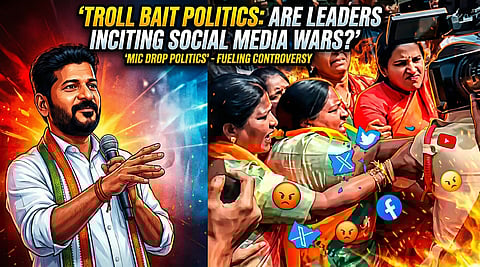

Telugu politics has turned into a noisy stage where microphones do more than amplify voices—they spark wildfires. These days, politicians don’t just slip up and move on. They toss out calculated, inflammatory lines, then watch as social media does the rest. Andhra Pradesh and Telangana prove this better than anyone. Drop a provocative sound-bite, and overnight, you’re trending. Never mind the fallout for public dialogue or the peace between states.
Coconut Crisis and the ‘Evil Eye’ Gambit
Take Andhra Pradesh’s Deputy Chief Minister, Jana Sena Chief Pawan Kalyan. He’s an actor-turned-politician, and on his recent tour of drought-stricken Konaseema, he didn’t blame climate change or TDP-led coalition government missteps for dying coconut trees. Instead, he pointed the finger at “Telangana Dishti”—Telangana’s supposed ‘evil eye’. Pawan Kalyan’s own roots are tangled up with Hyderabad, Telangana’s capital. Still, he claimed Telangana’s good fortune had somehow cursed Andhra’s crops. He delivered his accusation with the drama only a film star can muster, dragging the conversation from policies into an all-out battle of regional pride. Telangana’s Congress party didn’t waste a second. Minister Komatireddy Venkat Reddy fired back, not just as a party leader but as the state’s Cinematography Minister. His threat: apologize now, or forget about screening your films in Telangana. Suddenly, Pawan Kalyan faced a choice—was he with his ‘home’ or his ‘rival’? Other leaders piled on, reminding him that both his acting and political careers owed plenty to Telangana fans.
Consequences & the Tally
The real crisis—the Konaseema drought—barely made the news. Instead, everyone watched as AP and Telangana traded blows. The rhetoric only deepened old regional divides, turning a natural disaster into a mud-slinging contest. Meanwhile, film distributors and theater owners in Telangana braced for a hit, caught in the middle of a political ego clash that had nothing to do with them.
Divine Analogy and the Godly Outrage
Telangana Chief Minister A. Revanth Reddy didn’t just stir the pot—he lit a fuse. In a closed-door Congress executive meeting, he tried to make a point about the party’s internal divisions by comparing them to the variety in the Hindu Pantheon. As he put it, Hindus have different gods for different things: Hanuman for the unmarried, others for those with specific dietary habits, and so on. If even religion has this much diversity, he argued, how can anyone expect a political party to rally around a single leader?. Maybe he meant it as a harmless, even playful comment about pluralism. But the moment those words left the room, they landed in a storm. The BJP wasted no time. They plucked the remark out of its context and painted it as a direct insult to Hindu beliefs.
TBJP Protest at Gandhi Bhavan
Union Minister Bandi Sanjay Kumar and the Telangana BJP quickly mobilized. They called for sweeping protests and marched on Gandhi Bhavan, the Congress party’s headquarters. The air filled with chants of “Jai Shri Ram.” BJP leaders accused the Chief Minister of harbouring deep animosity toward Hindus, linking his words to past comments and his political alliances. For them, this wasn’t just a gaffe—it was a betrayal. They demanded an unconditional apology. Meanwhile, the Congress, blindsided, scrambled to contain the damage. Party spokespersons insisted Revanth Reddy’s remarks were just everyday Telugu sayings—meant in jest, not as an attack on anyone’s faith. They tried to reframe the conversation, arguing he was simply highlighting the party’s inclusivity.
New Political Economy of Outrage
These aren’t an isolated incidents. It’s a perfect snapshot of what’s become the new normal in Indian politics—what you might call the ‘Controversy-Industrial Complex.’ Leaders don’t need to spend big on ads anymore; they just need to drop a provocative line. That’s enough to set the news cycle ablaze, trigger outrage from rivals, and guarantee wall-to-wall coverage on TV and social media. Public debate grows louder, more polarized, and obsessed with outrage for its own sake, while real issues—rising prices, unemployment—slip quietly into the background. In a world where the loudest provocation wins, it’s all too easy to manufacture a crisis. Sure, it delivers quick political returns, but it chips away at the foundations of democracy, drowning out real debate in endless, orchestrated noise.
