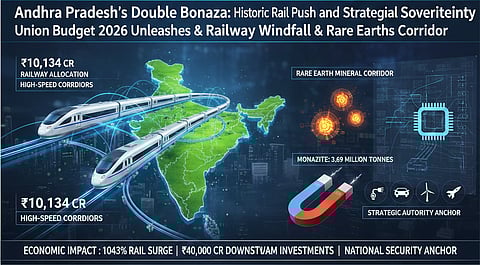

The Union Budget 2026–27 has propelled Andhra Pradesh into the national limelight. This isn’t just about a few new train routes or a marginal budget bump. With a staggering Rs 10,134 crore allotted to railways and Andhra Pradesh’s emergence as a Rare Earth Mineral Corridor, the Centre has sent a clear message: the state is stepping into the core of India’s industrial and strategic plans.
Railway Windfall: An 11-Fold Surge
Union Railway Minister Ashwini Vaishnaw made history—this marks Andhra Pradesh’s largest railway allocation ever. It’s an 11-fold jump from the 2009–14 average, soaring from Rs 886 crore to over Rs 10,000 crore. And this isn’t a one-off. It forms part of Andhra Pradesh’s massive Rs 92,649 crore infrastructure pipeline. High-speed rail is where the excitement builds. Two of India’s seven planned High-Speed Rail Corridors will run right through Andhra Pradesh. It will reduce the journey time. Hyderabad to Bengaluru in two hours, and Hyderabad to Chennai in less than three hours. That’s not just quick—it’s transformative for business, travelers, and anyone weary of slow train journeys.
Station upgrades are well in progress. The Amrit Station Scheme is investing Rs 3,418 crore to modernize 73 stations across the state. Kakinada Town and Tuni stations are already complete, with the rest following suit. Safety upgrades are coming, too. The Kavach system—advanced anti-collision technology—is being deployed over 2,507 route-kilometers. The entire Andhra Pradesh rail network is now electrified, making it cleaner and more efficient.
Rare Earth Corridors: Countering the China Factor
Focus on the minerals. Rare Earth corridors story goes far beyond just digging in the dirt. The Union government has selected Andhra Pradesh as one of four states for a dedicated Rare Earth Corridor. It’s a direct move to challenge China’s dominance in these vital minerals. As industry experts say: “This isn’t just about mining ore. It’s about building an entire value chain—from raw materials to high-tech magnets used in EVs, wind turbines, missiles, and semiconductors.”
Andhra Pradesh is rich in resources. Its coastal sands contain around 3.69 million tonnes of monazite—the largest in India. Inland deposits include bastnaesite and allanite. The new corridor aims to directly link mining with the manufacturing of rare earth permanent magnets. The state receives an Rs 7,280 crore boost for this, targeting 6,000 MTPA capacity to finally break free from Chinese imports. The budget also reduces customs duties on mineral processing equipment and offers tax incentives for exploration under Section 51 of the IT Act.
Economic Analysis: The "Port-to-Plate" Synergies
All these elements connect. With new railway funding, Andhra Pradesh can efficiently transport minerals to processing centers and ports—Visakhapatnam, Kakinada, Krishnapatnam—at globally competitive costs. Early economic analyses suggest the rare earth sector alone could attract over Rs 40,000 crore in downstream investments. Think EVs, renewable energy, electronics. Tens of thousands of skilled jobs, all leveraging local resources. And crucially, by processing thorium-rich monazite, Andhra Pradesh will anchor India’s future nuclear energy ambitions. Still, it’s not just about impressive numbers. For any of this to materialize, the state must act swiftly on land acquisition, especially for the high-speed rail corridors and the 16,000 hectares designated for mineral projects. If the government can streamline approvals, Andhra Pradesh won’t remain just an agricultural state. By 2030, it’s poised to lead India’s next high-tech industrial leap.
