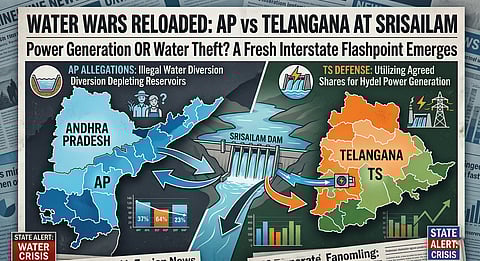

Almost ten years after the split between Andhra Pradesh and Telangana, the Srisailam reservoir is once again the stage for a fierce battle over resources. What started as a disagreement about hydroelectric power has spilled over into a full-blown political conflict about access to the Krishna River. As the water level keeps dropping, energy needs and irrigation demands are clashing, making it impossible to balance both.
"Move Like Brothers?" – Political Paradox
Politicians keep pushing for unity, but reality tells a different story. In Parliament, BJP leaders and others urged both states to act like family—work together, build capitals, cooperate for development. Yet on the ground, that message feels empty. The call for "brotherhood" stirred up protests in Telangana, not agreement. Telangana’s leaders argue: the wounds from bifurcation never healed. Their farmers are desperate for water, while AP—according to Telangana officials—cuts corners and takes what it needs, ignoring established guidelines.
Srisailam Flashpoint: 834 ft MDDL Violation
Telangana officially accuses AP of breaking the rules that protect reservoir survival. The Minimum Drawdown Level (MDDL) of Srisailam is set at 834 feet for good reason. Dropping below it means people can’t pump water for drinking or emergency irrigation. Telangana’s irrigation department has filed complaints with the Krishna River Management Board, blaming AP for sucking water out to power its Right Bank hydel station. But Telangana claims AP’s priority isn’t just power; they’re diverting huge amounts of water out of the Krishna basin, using the Pothireddypadu head regulator as cover.
With water levels inching dangerously close to—or even under—the critical 834 ft line, Telangana insists millions of farmers who depend on the Nagarjunasagar project downstream are losing their basic right to water.
Hydro vs. Irrigation Trade-off
The Srisailam dispute highlights a fundamental conflict: energy production versus irrigation. Hydroelectric plants need vast amounts of water to keep turbines spinning. Andhra Pradesh claims it’s simply using its share to meet soaring summer electricity demand. Telangana calls it “water theft.” They argue that AP’s approach leaves Telangana’s farmland dry because the released water skips their high-level irrigation canals. It’s a tug-of-war. Lights stay on in one state while fields wither in the other.
Krishna River Allocation Tensions Resurging
The Srisailam crisis exposes a larger institutional failure. After splitting in 2014, AP and Telangana settled on a 66:34 water sharing ratio. Telangana never agreed, demanding a 50:50 split until the Krishna Water Disputes Tribunal sets a permanent solution. The KRMB—the federal umpire meant to keep things fair—usually ends up powerless, urging both states to sort it out themselves.
As summer heat intensifies and Srisailam’s waters recede, tempers flare. The ongoing conflict proves one thing: unless the region gets a permanent, scientific, and enforceable water-sharing treaty, these "water wars" will keep undermining any hope for real cooperation.
