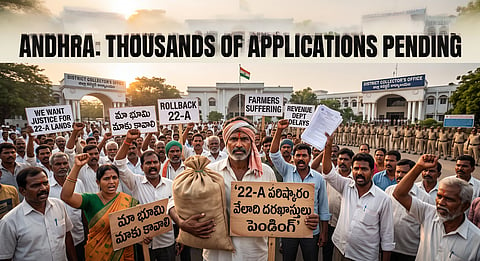

The Section 22A land dispute is still one of the most heated socio-political battles in South India. Just in Andhra Pradesh, it's blocked registrations for almost 2.2 million acres. When lawmakers first introduced Section 22A under the Registration Act of 1908, they wanted to shield state-owned, endowment, and assigned lands from illegal grabs. Over time, though, bureaucratic confusion took over. Add some massive database problems, decades-old survey mistakes, and constantly shifting governments—and now, hundreds of thousands of legitimate landowners find them-selves stuck. This mess has set off major protests, court cases, and forced legislators to rethink the entire system.
Core of the Crisis: Security Turned Trap
At its core, Section 22A gives state governments the power to create a "prohibited properties list" and freeze the transfer, sale, or mortgage of anything on it. The rule covers six main types of land: government property, religious endowments like temple and Waqf land, lots assigned to the poor (which aren't supposed to be resold), plus land tied up in ongoing legal disputes or marked off for public policy reasons. On paper, this all sounds reasonable. In practice, though, the digital overhaul of land records—especially during Andhra’s 2017–2018 Land Records Updation drive and Telangana’s launch of the Dharani portal in 2020—turned Section 22A into a blunt instrument. Survey numbers got thrown into the database without warning owners. Suddenly, even private plots with perfect documents and decades of paid taxes were flagged, and owners were locked out overnight.
The Human and Economic Toll
The consequences cut deep, both in the countryside and in booming city neighbourhoods. For farmers, a Section 22A tag means their land is basically worthless as collateral. Banks won't touch it, which means no loans for seeds or new equipment—and they're often unable to even pay off older debts. Groups like the Centre for Liberty have rallied farmers, pointing out that lakhs of families lost basic land rights with no legal justification. In the cities, places like Hyderabad’s Gopanpalli or Tirupati’s Auto Nagar saw real estate chaos. Buyers who’d paid advances showed up for registration, only to see the deal blocked at the last minute.
In the aftermath, thousands have spent years going from one office to the next hoping for a fix. In some cases, high-profile interventions—like the Telangana High Court case by retired Judge Abhinand Kumar Shavili—were needed to challenge what looked like arbitrary district-level blacklisting.
Political Tug-of-War and Reform Blows
Naturally, the Section 22A headache has become a political weapon too. In Andhra Pradesh, Chief Minister N. Chandrababu Naidu’s coalition government has gone after the previous YSRCP regime, accusing them of using Section 22A and the now-scrapped Land Titling Act to hassle landowners and stall clearances. Revenue Minister Anagani Satya Prasad has kicked off a string of reforms, targeting the removal of wrongly listed private lands.
To counter public anger, the Andhra Pradesh government issued landmark guidelines freeing five major categories of land from the 22A prohibited listings:
· Lands originally assigned to Defence Personnel.
· Plots designated for Freedom Fighters.
· Lands granted to Political Victims under historic compensation plans.
· Old land assignments finalized before June 18, 1954.
· Verified Private Patta Lands incorrectly caught in digitization sweeps.
22A RESOLUTION PROGRESS (2025–2026)
- Andhra Pradesh has released about 1.37 lakh acres as of June 2026.
- Guntur’s century-old Vatticherukuru tank dispute is finally settled.
- Mangalagiri freed 1,622 residential houses under Section 22A(1)(a).
- Telangana has a high-level committee still double-checking its prohibited list.
Institutional Obstacles and the Road Ahead
Even with all this momentum, real change on the ground is still tough. Despite “special drives” and complaint centers led by District Collectors, field-level officials are often hesitant—they don’t want to clear a property and then get blamed later if there’s a state claim. The Andhra Pradesh High Court recently criticized this attitude, warning revenue officers not to drag their feet or dodge orders, especially when a government approval memo has already been issued.
Fixing the Section 22A gridlock for good will take some real policy courage. States need to start splitting disputed land from clean survey areas instead of freezing everything, and make notification automatic before adding anyone’s land to the blacklist. Unless administrative tech starts matching up with real-world records, Section 22A will keep blocking both land rights and a healthy real estate market.
