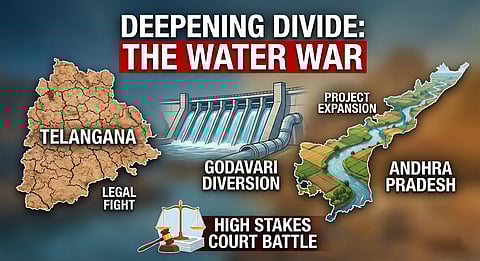

Tensions over water between Telangana and Andhra Pradesh have finally erupted into a courtroom battle. This week, Telangana went to the Supreme Court, demanding a halt to the Polavaram-Nallamala Sagar Link Project (PNLP). With a staggering price tag of ₹58,000 crore, this project—once called the Polavaram-Banakacherla Link—is the newest battleground in a fight that’s dragged on since the two states split in 2014.
What’s really at stake here is water, plain and simple. Telangana, downstream and often parched, needs relief from drought. Andhra Pradesh, upstream, wants to protect what it sees as its fair share of “assured” water. Telangana says Andhra Pradesh is rewriting the rules, blowing up the original Polavaram project—which only allowed for 80 TMC of water to be sent to the Krishna basin—into a monster that could move 200, maybe even 300 TMC.
Andhra Pradesh hasn’t waited for the Godavari Water Disputes Tribunal (GWDT) to weigh in. There’s no approved Detailed Project Report (DPR), no nod from the Central Water Commission (CWC). Instead, construction races ahead, as if it’s easier to build first and argue later. Andhra Pradesh insists it’s only using “surplus floodwaters” that would just flow out to sea—trying to bring water security to Rayalaseema, where drought is chronic. But let’s be real: “surplus” is slippery, especially with climate change reshaping rainfall. If the Supreme Court doesn’t step in and demand a proper, science-backed review from all sides, this isn’t just another legal fight. It’s a deepening emotional and economic rift between two states that depend on the same river.
Technical Aspects of the “Link” Project
The project itself is ambitious. It aims to link the Godavari River at Polavaram Dam with the Krishna and Penna basins. The name changed—from Banakacherla to Nallamala Sagar—after pushback and canceled tenders, but the core idea remains.
Original Plan - Polavaram-Banakacherla Link: The original goal was straightforward: send water to Rayalaseema’s drought-hit districts (Nandyal, Kurnool, Anantapur, Kadapa). This meant boosting the Polavaram Right Main Canal’s capacity from 17,500 to 38,000 cusecs. The water would travel to the Banakacherla Cross Regulator, a crucial point feeding the Telugu Ganga, Srisailam Right Bank Canal, and Galeru Nagari projects.
Revised Plan - Polavaram-Nallamala Sagar Link: After objections, Andhra Pradesh updated the plan. Now, the project centers on a huge balancing reservoir at Bollapalli (in Palnadu district), with room for almost 400 TMC. Water would be lifted through tunnels under the Nallamala forest to the Nallamala Sagar Reservoir, part of the Veligonda project in Prakasam district. Telangana claims Andhra Pradesh is building infrastructure to draw 2 TMC per day—far beyond the 80 TMC per year that the Bachawat Tribunal and GWDT awards allow.
Telangana’s Arguments
In its December 2025 petition to the Supreme Court, Telangana argues that Andhra Pradesh is acting alone and illegally expanding the project, violating the water-sharing rules set during the bifurcation. Telangana points to the GWDT Award, which only allows 80 TMC to be diverted to the Krishna Delta. By redesigning the system to handle 200–300 TMC, Andhra Pradesh, they argue, is simply taking Godavari water without a new tribunal decision.
Telangana also says that calling the diverted water “surplus” or “flood” water doesn’t hold up—these waters haven’t been allocated, and Telangana’s own drought-prone regions still need them. Under the AP Reorganisation Act of 2014, Telangana says, only the Central Government or the Polavaram Project Authority can propose changes to a National Project like Polavaram. Instead, Andhra Pradesh pushed ahead without required clearances, even after the CWC told them to stop.
Beyond the paperwork, Telangana is worried about safety. They warn that Andhra Pradesh is increasing the project’s discharge capacity—from 36 lakh to 50 lakh cusecs—raising the risk of dangerous backwater flooding in Bhadrachalam temple town, and nearby tribal areas. For Telangana, this isn’t just about water rights or legal technicalities. It’s about survival, security, and fairness in a battle that’s only growing more urgent. Finally, the state highlights the ecological threat posed by blasting tunnels through the Nallamala Tiger Reserve, arguing that the project lacks the necessary environmental and forest clearances to proceed.
