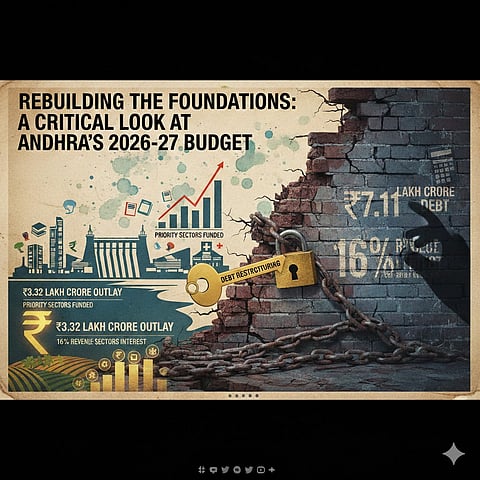

TDP-led Coalition government’s presentation of Andhra Pradesh’s 2026-27 budget signals a clear change in direction. The “Double Engine” government calls it the roadmap for “Swarna Andhra 2047,” but it’s really a balancing act—pouring money into headline-grabbing welfare programs while trying to pull the state out of years-long industrial stagnation. The numbers look big: a ₹3.32 lakh crore budget. But behind the ambition, Andhra’s debt keeps piling up, casting a long shadow over every bold promise.
Six Pillars: Where the Money Goes
At its core, the budget splits between safety nets and a race to build infrastructure. The major targets are clear:
Education gets the largest chunk—₹32,308 crore. The government’s betting on schools to build future talent. A hefty ₹9,668 crore goes to the Thalliki Vandanam scheme to keep kids from dropping out.
Agriculture and allied sectors see a separate ₹13,598 crore. The Annadata Sukhibhava scheme, which puts cash directly in farmers’ hands, claims ₹6,600 crore.
Welfare spending balloons to ensure “inclusive growth”: ₹51,012 crore for Backward Classes, ₹20,644 crore for Scheduled Castes, and ₹9,190 crore for Scheduled Tribes.
Irrigation and water security aren’t left out. The Polavaram Project, a long-standing dream, gets ₹6,105 crore, with another ₹9,906 crore for other big irrigation projects meant to fight drought.
Infrastructure and Amaravati, the so-called People’s Capital, get a revival—₹6,000 crore set aside for city development. There’s also a new “Quantum Valley” initiative, a signal that Andhra wants to play in the deep-tech future.
Healthcare, under the Dr. NTR Vaidya Seva Trust, gets ₹4,000 crore, aiming to keep care affordable even as private costs surge.
Budget Math: Debt vs. Ambition
Look closer at the budget math and the struggle becomes obvious. Andhra Pradesh’s public debt will hit a staggering ₹7.11 lakh crore by March 2027. The state talks up its 36% debt-to-GSDP ratio as “stable,” but that’s just spin—the sheer size of the debt is worrying. About 16% of the state’s revenue now goes straight to paying interest, leaving less and less for real investment in growth.
The total outlay—₹3,32,205 crore—is higher than last year’s, but the fiscal deficit still sits at a stubborn 3.84% of GSDP. That’s slightly better than last year’s 4.57%, yet well above the 3% that most economists say is healthy.
The government’s answer…debt restructuring. Renegotiating ₹43,298 crore in loans has saved around ₹327 crore a year so far. They want to restructure another ₹1.2 lakh crore, but it’s like running a marathon while fixing your shoes at the same time.
Repair and Rebuild
This budget is less about grand new ideas and more about patchwork. Welfare spending protects the most vulnerable, but the state faces a deeper problem: revenue isn’t growing fast enough to keep up with its debt payments. If Andhra really wants to become “Swarna” Andhra, it has to move from just handing out benefits to actually generating wealth—faster than the interest on its loans can catch up.
