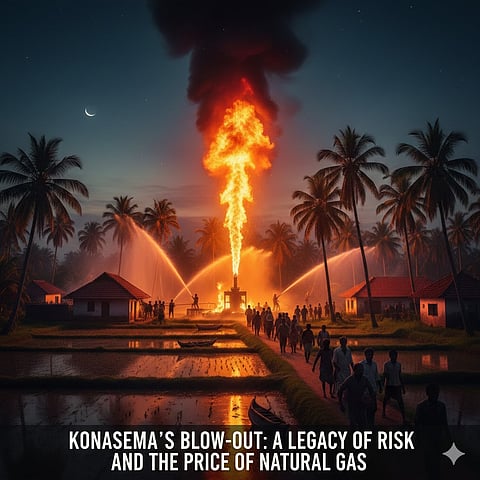

The Konaseema delta—lush, green, and often called the "Kerala of Andhra Pradesh"—is glowing again, but not with the light anyone wants. On January 5, 2026, what started as routine work at ONGC’s Mori-5 well in Irusumanda village turned into a nightmare. Gas escaped, pressure controls failed, and suddenly a 20-meter wall of fire rose over the coconut groves. More than 600 people had to run for their lives. This time, nobody died, at least officially. But the “Mori-5” fire is another jolt for people living in the Krishna-Godavari Basin. Here, the ground offers wealth, but always with a catch: prosperity laced with fear.
Fear of Blowouts in Konaseema
Blowouts in Konaseema aren’t just technical disasters—they’re personal ones. In industry jargon, a "blowout" means all control is lost, gas or oil bursts out, and the risk of fire or explosion skyrockets. At Mori-5, the gas first rolled out as a heavy white mist, spreading across the rice fields. Then came the flames. Crisis teams rushed in, set up “water umbrellas” to beat back the heat, and diverted irrigation canals to keep the blaze from spreading. These are the heroics you read about in reports. But for people here, it’s burned paddy, dead cows, and a sickening uncertainty. When will it be us next?
A Chronology of Fire: Konaseema’s Dark Timeline
Konaseema’s history with gas is a grim timeline that locals know by heart.
January 1995: Pasarlapudi. The biggest onshore gas fire India has ever seen. For 65 days, a column of fire lit up the sky, visible for miles. Global experts flew in, but ONGC’s own crew finally stopped it. Thousands were uprooted. The scars linger—Pasarlapudi became a textbook case worldwide for how not to lose control.
June 2014: Nagaram. Not a blowout at the wellhead, but a pipeline disaster. A rusted GAIL line leaked, and a tea vendor’s stove set off an explosion that killed 23 people and leveled the village. Suddenly, the story wasn’t just about “technical glitches.” People started talking about criminal neglect—aging pipes, forgotten maintenance.
2014–2024: The leaks that don’t make headlines. In Konaseema and Tatipaka, small leaks and flares keep happening. They rarely kill, but they do something quieter—farmers lose crops, soil gets poisoned, and trust in the system keeps leaking away. Promises of compensation rarely turn into real help.
January 2026: Now, Mori-5. The first “big fire” in decades. There’s a twist this time: the well’s maintenance was outsourced to a private contractor, Deep Industries. Outsourcing is supposed to bring efficiency, but the flames at Mori-5 are bound to force a hard look at how third-party operators handle safety.
Safety beyond the Capping
Right now, expert teams from Mumbai and Delhi are scrambling to cap the well and put out the fire. But putting out the flames isn’t enough. Konaseema’s gas helps keep India’s lights on, but the risks stay local. People here see the wealth leaving, but they live with the danger. From Pasarlapudi to Nagaram to Mori, the cycle repeats. Safety manuals and procedures sound fine on paper, but they start to look thin when pipelines snake through people’s backyards, and gas wells sit among coconut trees.
What would real safety look like in the Krishna-Godavari Basin? Three things, at least:
- Transparent audits. Every pipeline, every well-site—especially the old ones and those run by contractors—needs public safety reports anyone can access.
- Modern warning systems. Gas sensors in villages should warn residents the moment there’s a leak, not just alert people in distant control rooms.
- Fair compensation. When crops burn or land is ruined, farmers need help fast, without red tape.
In the end, the flames in Konaseema always die down, but fear sticks around. Until the industry puts local lives on par with gas output, this beautiful delta will keep living with the shadow of the next fireball.
